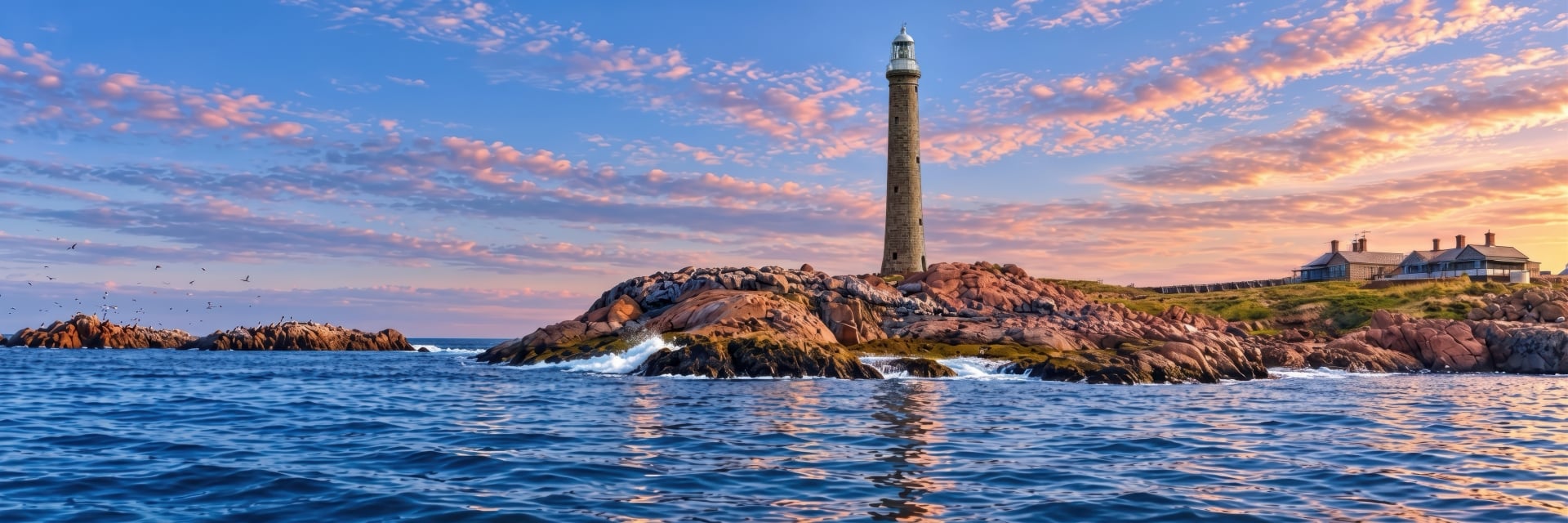
Gabo Lighthouse from the Water
GEN-PANO-013The granite tower from the sea. Pink rock, keepers’ cottages and a sky of evening colour on Gabo Island.
Documentary Photograph: The granite coast of Gabo Island from the water — pink rock, ocean surge, and the wave-battered ledges where seals haul out to rest (Panorama by Colin Dixon).
From a passing boat off the southern tip of Gabo Island, they look at first like wet granite boulders.
They lie piled in loose groups across the pink rock shelves, dark and seemingly motionless against the spray. The Tasman swell rolls in, breaks into white foam along the lower ledges, and washes across the stone without disturbing them.
Then one rolls onto its side.
A massive bull lifts a heavy, square-muzzled head, exhales a deep steamy breath into the cold wind, and scratches its flank with the tip of a hind flipper before collapsing back into slumber.
These are Australian Fur Seals — the heaviest, most imposing marine mammals that call Gabo’s shoreline home.
To walk the granite perimeter of Gabo or look down from the lighthouse headland is to realize that the island does not end at the tide mark. For hundreds of fur seals moving through the rich waters of East Gippsland, Gabo Island and neighbouring Tullaberga Island are indispensable sanctuaries — places to haul out, warm their blood in the sunshine, and recover between demanding ocean forays.
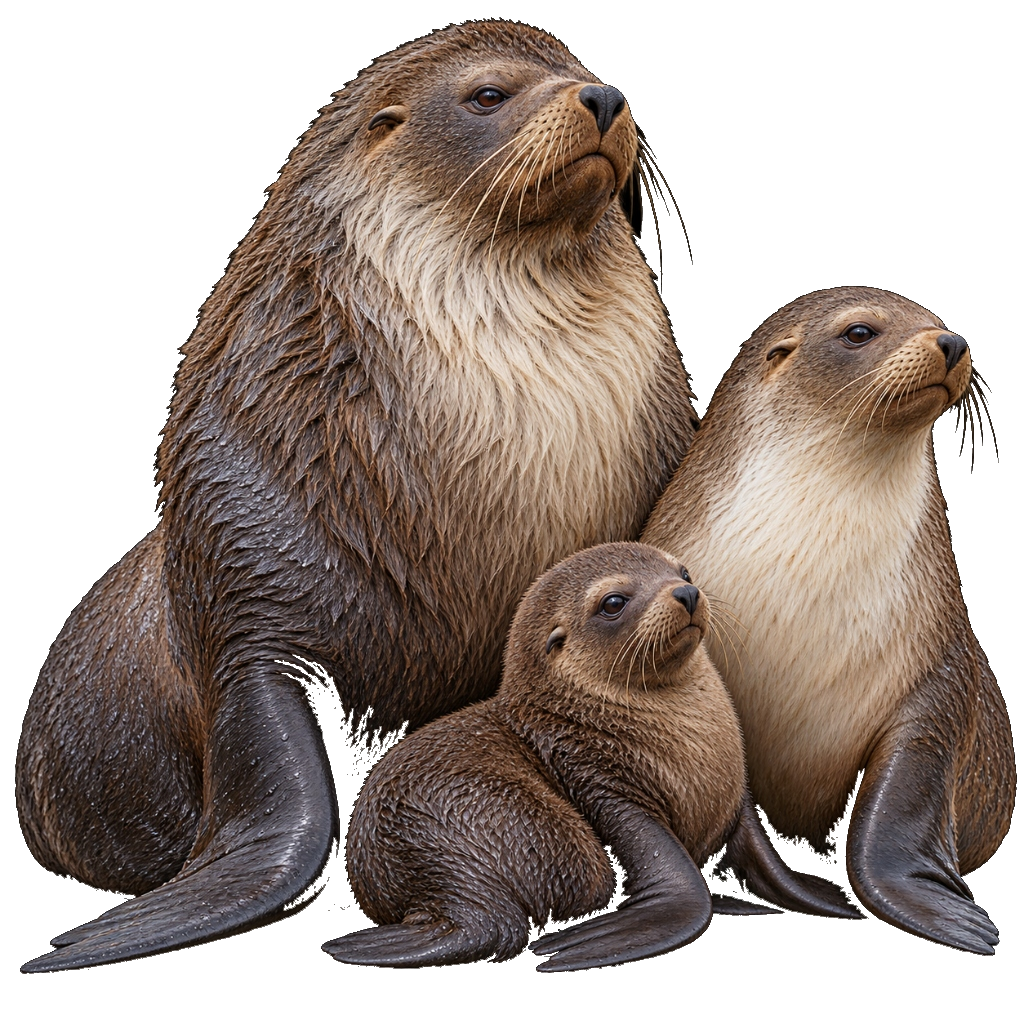
Arctocephalus pusillus doriferus — adult male with heavy blonde-streaked mane and blunt muzzle, accompanied by female and dark chocolate pup.
Australian Fur Seal at a glance
| Common name | Australian Fur Seal |
|---|---|
| Scientific name | Arctocephalus pusillus doriferus |
| Authority | Wood Jones, 1925 |
| Family & Order | Otariidae (Eared Seals) · Carnivora |
| Adult male size | 2.0–2.25 metres · 220–360 kg (massive mane & shoulders) |
| Adult female size | 1.2–1.7 metres · 50–110 kg (fawn to silvery chest) |
| Pup birth coat | Black to dark chocolate brown (moults at 3–4 months) |
| Typical diving depth | 60–150 metres (benthic foraging, max ~200 m) |
| Primary diet | Squid, octopus, cuttlefish, flathead, red cod, barracouta |
| Gabo role | Primary non-breeding haul-out & seasonal foraging base |
| Conservation status | Protected marine species (EPBC Act & Victorian Wildlife Act 1975) |
The Australian Fur Seal is an endemic subspecies of the Afro-Australian Fur Seal (Arctocephalus pusillus). The nominate subspecies (A. p. pusillus) inhabits the coasts of southern Africa.
The Heavyweight of the Pinnipeds
Among the nine species of fur seals found worldwide, the Australian Fur Seal is the largest of them all.
A mature breeding bull is an animal of staggering bulk. Reaching more than 2.2 metres in length and tipping the scales at up to 360 kilograms, a bull possesses a thick, heavily muscled neck covered in a coarse, yellowish-grey to blonde mane. His muzzle is broad and blunt, his canine teeth large and formidable, and his chest deep and broad.
Females look almost like a different species.
Weighing between 50 and 110 kilograms, cows are far more slender and streamlined, clothed in a silky coat of silvery fawn with pale creamy throats. This dramatic size difference — sexual dimorphism — is driven by the brutal territorial battles bulls wage on breeding islands, where sheer body mass determines who controls prime pupping territory (Australian Museum).
On Gabo Island, however, the mood is distinctly calmer.
The Art of Warming Up
Water conducts heat away from a warm-blooded body roughly twenty-five times faster than air. For a marine mammal hunting in the cold upwelling waters of Bass Strait, keeping warm requires constant thermodynamic management.
Fur seals do not rely solely on blubber like true seals and whales; they possess a dense underfur beneath their coarse guard hairs. But when spending days diving in cold water, their extremities lose heat.
That is why the pink granite of Gabo is so valuable.
On sunny days, the dark feldspar and quartz of the granite absorb the heat of the sun. The seals haul themselves out of the surge, shake off sheets of seawater, and drape their bodies across the sun-baked stone.
In the water, you will often witness another signature behaviour: the “jug-handle” pose.
A seal will float motionless at the surface, rolling onto its back and lifting one large foreflipper and both hind flippers out of the water, forming a curved loop resembling the handle of an earthenware jug. By exposing the blood vessels in their unfeathered flippers to the warm air and sunlight while keeping the rest of the body submerged, they absorb solar energy and circulate warm blood back to their vital organs.
What looks like lazy sunbathing is a masterclass in mammalian thermal engineering.
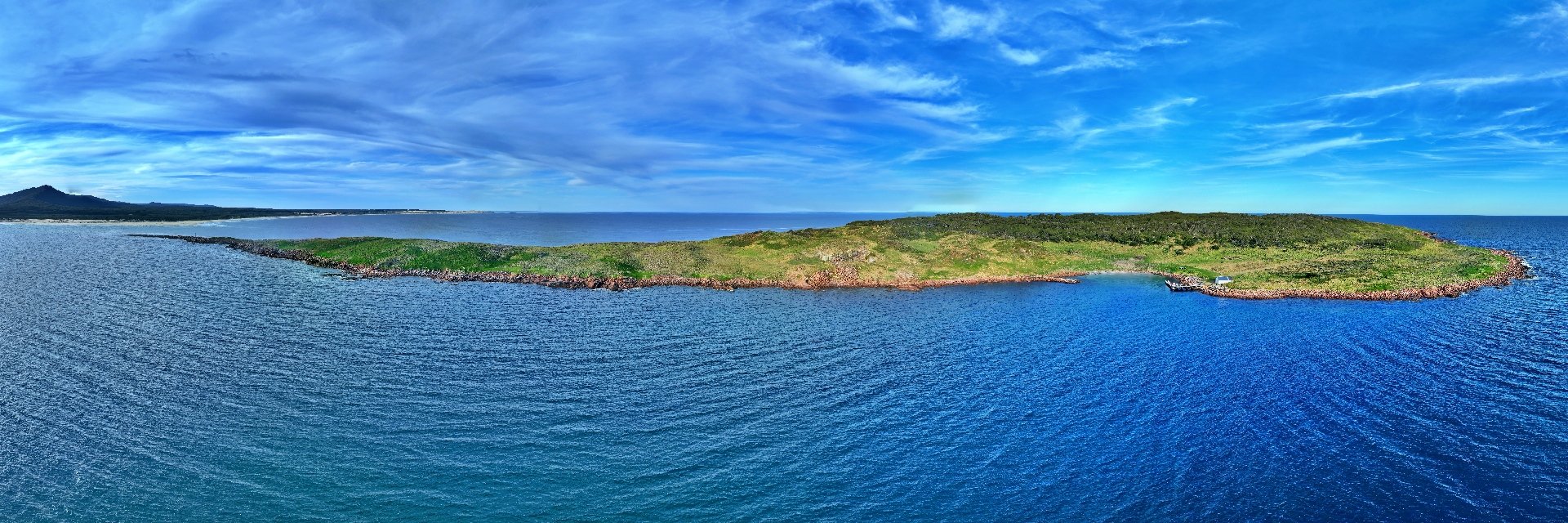
Gabo Island from the Sea
GEN-PANO-010The whole island from the water. Forested granite, a rocky cove and the East Gippsland mainland coast beyond.
Documentary Photograph: Looking over Gabo Island from the water — the forested interior, rocky coves, and the East Gippsland coastline across the channel (Panorama by Colin Dixon).
Gabo and Tullaberga: Sanctuaries of the East
It is important to distinguish between a seal breeding colony and a haul-out site.
The major breeding rookeries of the Australian Fur Seal in Victoria are concentrated on isolated, uninhabited islands further west — notably Kanowna Island off Wilsons Promontory, Seal Rocks off Phillip Island, and Lady Julia Percy Island near Port Fairy. On those crowded breeding islands, hundreds of pups are born each November and December amid thunderous roaring and territorial fighting.
Gabo Island and adjacent Tullaberga Island serve a different, equally vital role: they are primary non-breeding haul-outs.
Here you find bachelor bulls resting between breeding seasons, sub-adult males developing their strength, non-breeding females, and weary foragers taking refuge during rough weather.
Sitting right at the intersection of the warm East Australian Current flowing south and the cold sub-Antarctic waters pushing through Bass Strait, Gabo provides immediate access to productive feeding grounds. Seals forage over the continental shelf, diving repeatedly to the sea floor to hunt octopus, arrow squid, and reef fish, before returning to Gabo’s rocks to sleep.
The Dark Century of the Fur Trade
The abundance of seals around Gabo today is something that was nearly lost forever.
In the late eighteenth and early nineteenth centuries, south-eastern Australia witnessed an unbridled, industrial-scale slaughter. British and colonial sealers swept through Bass Strait and along the Gippsland coast, clubbing hundreds of thousands of seals to death for their luxurious pelts and rich blubber oil.
By the 1830s, the seal colonies were so decimated that the industry collapsed under its own devastation. An estimated quarter of a million Australian Fur Seals had been reduced to small, fragmented remnants clinging to the most inaccessible offshore rocks.
Full legal protection finally arrived in the twentieth century.
Over decades of patient recovery under state and federal wildlife legislation, Australian Fur Seals have steadily recolonized their historical range. Their return to the granite shelves of Gabo Island is a visible sign of an ocean ecosystem slowly regaining its balance.
“Two centuries ago, commercial sealers almost silenced the roar of fur seals on these granite shores. Today, the seals have returned — claiming their ancient place on the rocks.”
How to Tell It from the New Zealand Fur Seal
Gabo Island is one of the places where Australia’s two fur seal species share the same coast.
At a casual glance, wet seals lying on a rock look similar. But a few clear diagnostic clues will help you recognise the Australian Fur Seal immediately:
- A broad, blunt muzzle: The face is square and dog-like, without a sharp upturned tip.
- Enormous, heavy frame: Adult males are much larger and bulkier, with a heavy pale or yellowish-grey mane around the neck.
- Lighter coloration: When dry, females and younger seals display rich fawn to silvery-grey coats with pale chests.
- Gentler resting ledges: Australian Fur Seals tend to sprawl across wide, flat granite slabs and gently sloping rock shelves rather than squeezing into steep, chaotic boulder piles.
By contrast, the Long-nosed (New Zealand) Fur Seal is darker, sleeker, and possesses a conspicuously pointed snout with exceptionally long whiskers.
If You See Seals on the Rocks
Observing Australian Fur Seals on Gabo Island is an unforgettable wildlife experience, but it requires common sense and respect.
Under Victorian wildlife regulations, visitors must keep a respectful distance from hauled-out seals (at least 30 metres on land, and 50 metres by water). A 300-kilogram bull can move with surprising speed across granite boulders using all four flippers if he feels threatened or cornered.
Never put yourself between a seal and the ocean. The sea is their sanctuary, and if a seal feels its escape route is blocked, it may charge.
Keep your distance, sit quietly on the higher rocks, and watch. Listen to the low grunts, the sneezing breaths, and the barking cries carrying across the surf.
The tide rises against the pink granite.
A large bull slides into the foam with barely a splash.
And in an instant, a clumsy land sleeper becomes an effortless master of the ocean.