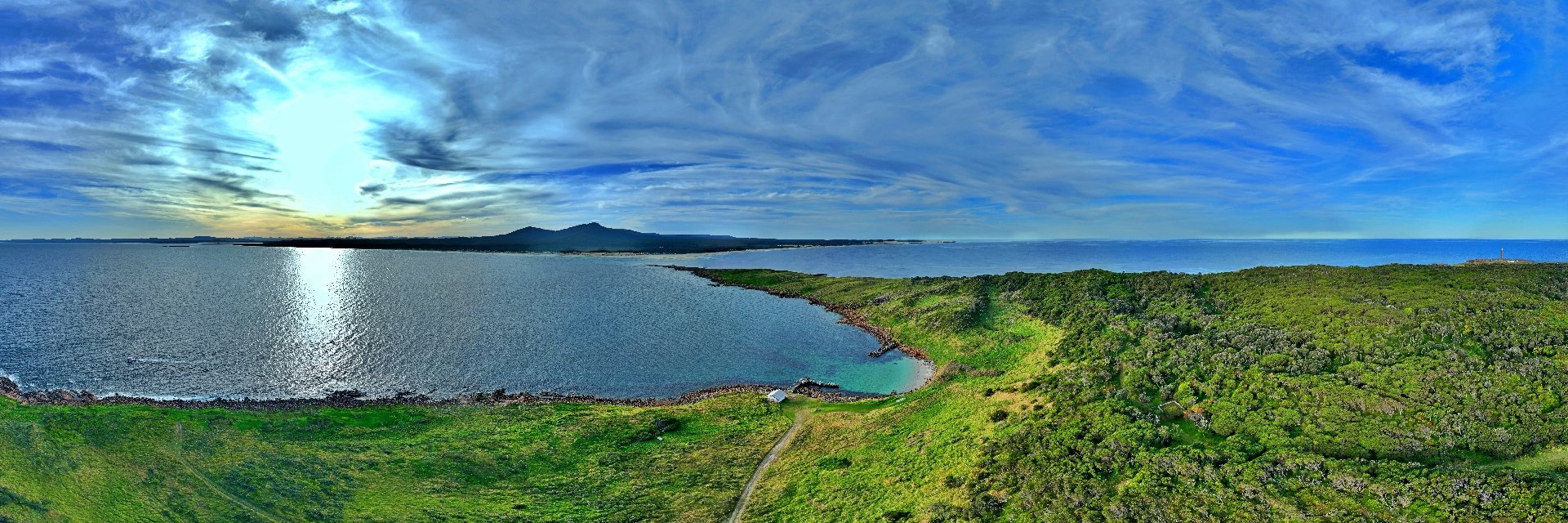
From Gabo Island to the Mainland
GEN-PANO-012Looking toward the mainland from the island. Sun on the water, the Howe Ranges and a glimpse of the lighthouse at the point.
Documentary Photograph: Looking west across the ocean swells from Gabo Island toward the Howe Range — the turbulent marine highway of the Long-nosed Fur Seal (Panorama by Colin Dixon).
Where the Australian Fur Seal looks for a wide, flat granite slab to sprawl under the sun, another seal chooses the chaos of the breaking swell.
On the outer eastern rocks of Gabo Island, where the full fetch of the Tasman Sea crashes against jagged pink granite, you will find darker, sleeker shapes perched high above the white water.
They balance effortlessly on slippery boulder piles that seem impossible to climb without hands.
A breaker hits the ledge, exploding into a ten-metre geyser of foam. When the water drains away through the rock gullies, the seal is still there — glistening black, shaking a spray of droplets from its long silver whiskers, gazing out into the spray with sharp dark eyes.
This is the Long-nosed Fur Seal — historically and internationally celebrated as the New Zealand Fur Seal, and known to the Māori as Kekeno.
If the Australian Fur Seal is the heavy draft horse of the southern reefs, the Long-nosed Fur Seal is its agile, deep-diving thoroughbred cousin.
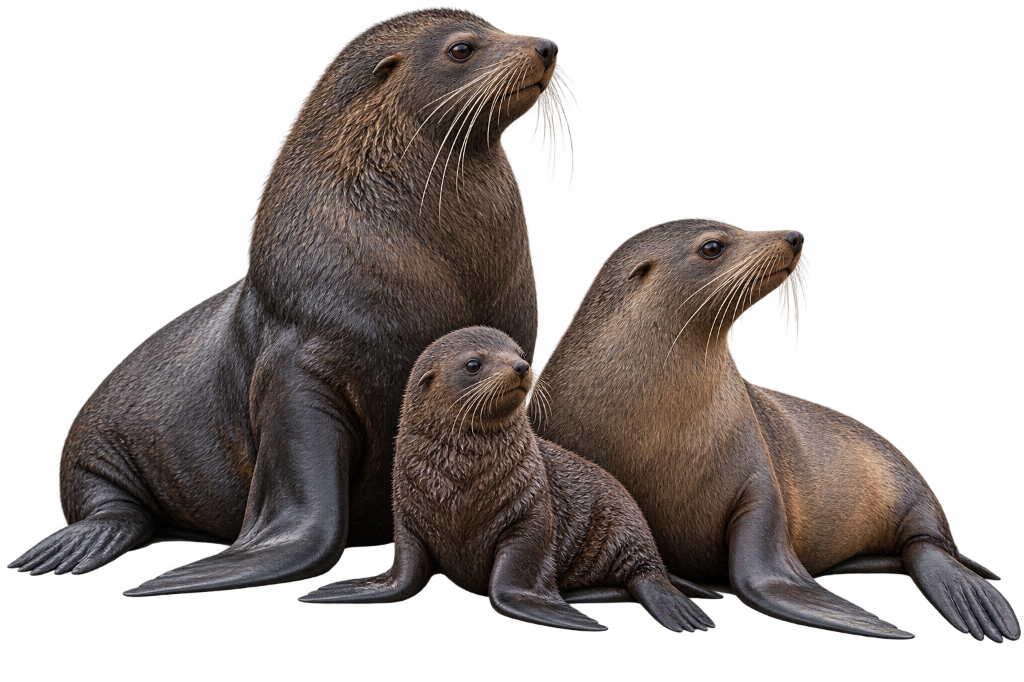
Arctocephalus forsteri — showing distinctive pointed, upturned muzzle, long pale whiskers (vibrissae), dark charcoal-grey pelage, and agile foreflippers.
Long-nosed Fur Seal at a glance
| Australian common name | Long-nosed Fur Seal |
|---|---|
| International name | New Zealand Fur Seal (Māori: Kekeno) |
| Scientific name | Arctocephalus forsteri |
| Authority | (Lesson, 1828) |
| Family & Order | Otariidae (Eared Seals) · Carnivora |
| Adult male size | 1.5–2.0 metres · 120–180 kg (pointed muzzle, dark coat) |
| Adult female size | 1.1–1.3 metres · 30–50 kg (slender, exceptionally agile) |
| Distinctive facial trait | Sharply tapered, upturned snout & very long white whiskers |
| Recorded diving depth | Routinely 100–300 metres (maximum recorded: 380 metres) |
| Primary diet | Arrow squid, lanternfish, barracouta, red cod, Little Penguins |
| Gabo habitat | Fractured boulder fields, surge channels & outer sea caves |
| Conservation status | Protected marine species (EPBC Act & Victorian Wildlife Act 1975) |
In Australia, the official common name endorsed by the Australian Faunal Directory and federal environment departments is Long-nosed Fur Seal to avoid geographical confusion, though the species is genetically identical to New Zealand’s Kekeno.
Two Names, One Ocean Nomad
The naming of Arctocephalus forsteri reflects the shared maritime heritage of the Tasman Sea.
In New Zealand, where the species has lived alongside Māori for centuries, it is revered as the Kekeno. International scientific databases and global wildlife texts almost universally list it as the New Zealand Fur Seal.
In Australia, however, wildlife authorities and the Australian Faunal Directory prefer the descriptive title Long-nosed Fur Seal. The rationale is simple: the species is an indigenous breeding resident of southern Australia as well as New Zealand, maintaining large colonies across South Australia, Western Australia, and the Bass Strait islands.
Whatever name you use, the animal is unmistakable once seen up close.
Its head tapers into a distinctly pointed, slightly upturned snout tipped with a button-like black fleshy nose. From the sides of its muzzle extends an impressive spray of long, flexible pale whiskers (vibrissae) that sweep well past the ears. These whiskers are packed with nerve endings, acting as underwater radar capable of detecting the minute hydrodynamic turbulence left by fleeing fish in pitch-black ocean depths (Australian Museum).
Extreme Divers of the Continental Shelf
While Australian Fur Seals forage primarily along the shallow continental shelf floor (benthic divers), the Long-nosed Fur Seal is an extreme, pelagic deep-diver.
Equipped with flexible rib cages, high concentrations of myoglobin in their muscles, and the ability to slow their heart rates to a few beats per minute, these seals are built for the abyss.
Time-depth recorders attached by researchers have documented Long-nosed Fur Seals plunging past 300 metres, with the deepest dives reaching an astounding 380 metres — lasting more than twelve minutes on a single breath of air.
They hunt predominantly at night, targeting bioluminescent lanternfish, arrow squid, and pelagic cephalopods that migrate up from deep ocean trenches toward the surface under the cover of darkness.
When dawn breaks over Gabo Island, these deep-sea hunters return to the rocks to digest their catch and sleep through the midday heat.
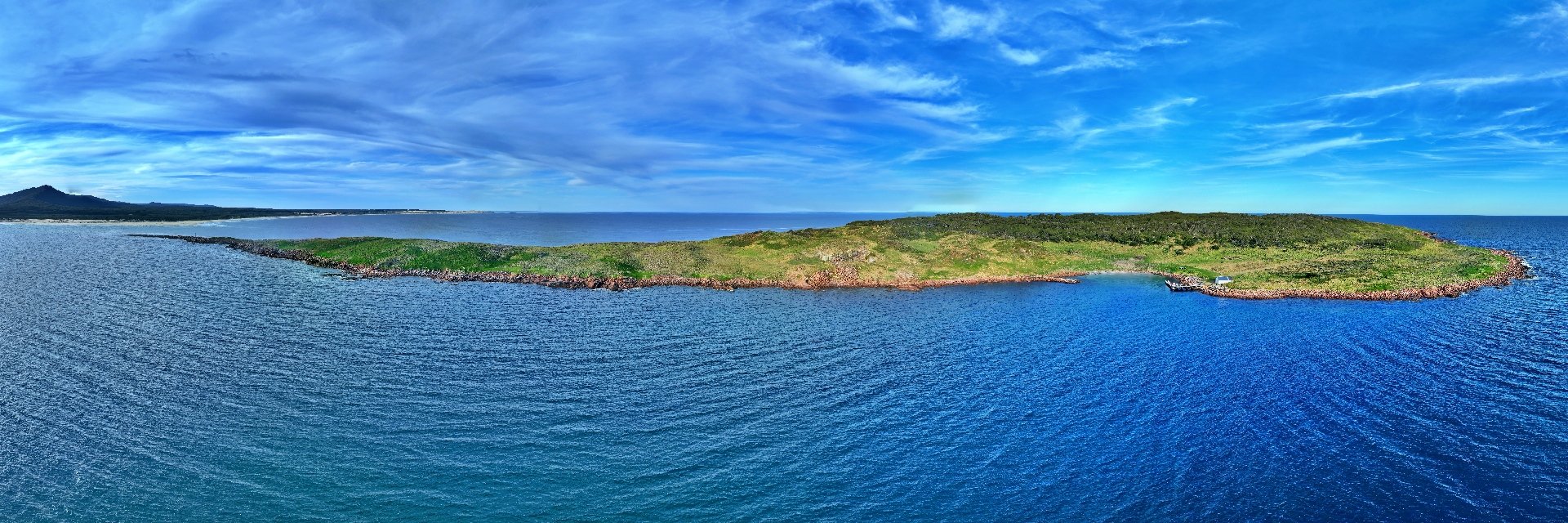
Gabo Island from the Sea
GEN-PANO-010The whole island from the water. Forested granite, a rocky cove and the East Gippsland mainland coast beyond.
Documentary Photograph: Gabo Island from the sea — the exposed pink granite boulders and surging coves favored by Long-nosed Fur Seals (Panorama by Colin Dixon).
The Penguin Connection: A Dynamic Food Web
On Gabo Island, the story of the Long-nosed Fur Seal intersects directly with that of the island’s famous Little Penguins.
While Australian Fur Seals feed almost exclusively on fish and squid, Long-nosed Fur Seals are opportunistic predators with a broader palate.
Ornithologists and marine biologists studying south-eastern Australian waters have documented Long-nosed Fur Seals actively hunting seabirds — including Short-tailed Shearwaters and Little Penguins.
In recent years, researchers monitoring the steep decline of Gabo Island’s Little Penguin colony have identified growing nearshore seal predation as one of the contributing pressures facing penguins as they raft offshore waiting for dusk.
This is not a story of “villains and victims”.
It is the raw, unscripted reality of an intact coastal ecosystem where top-tier marine predators and burrowing seabirds have coexisted for tens of thousands of years.
“The penguin, the shearwater, the sea-eagle, and the fur seal do not exist in isolation. Around Gabo Island, they are woven into a single, restless ocean food web.”
Built for the Southern Cold
How does a warm-blooded mammal survive hours in 11°C sub-Antarctic ocean currents without a whale’s thick layer of blubber?
The answer lies in the coat that nearly doomed the species to extinction.
A Long-nosed Fur Seal possesses two distinct layers of pelage:
- Outer guard hairs: Long, coarse, water-repellent hairs that shed moisture and protect against rocky abrasions.
- Dense underfur: An ultra-fine, velvety thicket containing an astonishing 300,000 hairs per square inch.
When the seal dives, water never actually touches its skin. The dense underfur traps a permanent cushion of dry air next to the body, forming an insulating wet-suit of trapped bubbles that retains body heat even hundreds of metres below the surface.
It was this impossibly soft, insulating underfur that attracted commercial sealers to southern Australia in the early 1800s.
The Return of the Kekeno
By 1830, relentless commercial sealing had wiped out almost every Long-nosed Fur Seal colony across south-eastern Australia and New Zealand. For over a century, sightings in Bass Strait and East Gippsland were extraordinary rarities.
Yet the species proved remarkably resilient.
Protected by law and sustained by remote island refuges in South Australia and sub-Antarctic New Zealand, colonies began to rebuild. Over the past forty years, their numbers have expanded steadily eastward.
Today, Long-nosed Fur Seals have firmly re-established themselves around Gabo Island, hauling out on the wild wave-splattered outer granite alongside Australian Fur Seals.
How to Tell the Two Seals Apart
If you spot a seal on the rocks of Gabo Island, look closely at the head and posture:
- Pointed vs Blunt Muzzle: The Long-nosed Fur Seal has a sharp, narrow, fox-like snout that tilts slightly upward. The Australian Fur Seal has a heavy, square, dog-like face.
- Whisker Length: Long-nosed Fur Seals have exceptionally long, dramatic pale whiskers that trail past their ears.
- Coat Colour: Long-nosed Fur Seals are uniformly darker — rich charcoal to near-black when wet, drying to deep greyish-brown.
- Habitat Choice: Look for Long-nosed Fur Seals on steep, broken boulder fields, surge gullies, and sea cave ledges where spray constantly flies.
If You See One on Gabo
Give them space. Long-nosed Fur Seals are agile, nervous, and quick to defend their ground.
Unlike heavy Australian Fur Seals who can take several seconds to lumber across flat stone, a startled Long-nosed Fur Seal can scramble over steep granite boulders with astonishing speed.
Stay at least 30 metres back, remain still, and watch them interact with the ocean.
A towering Tasman wave rushes toward the granite point.
A sleek charcoal head vanishes into the green face of the swell.
Seconds later, it emerges thirty metres out to sea — effortlessly riding the surge.