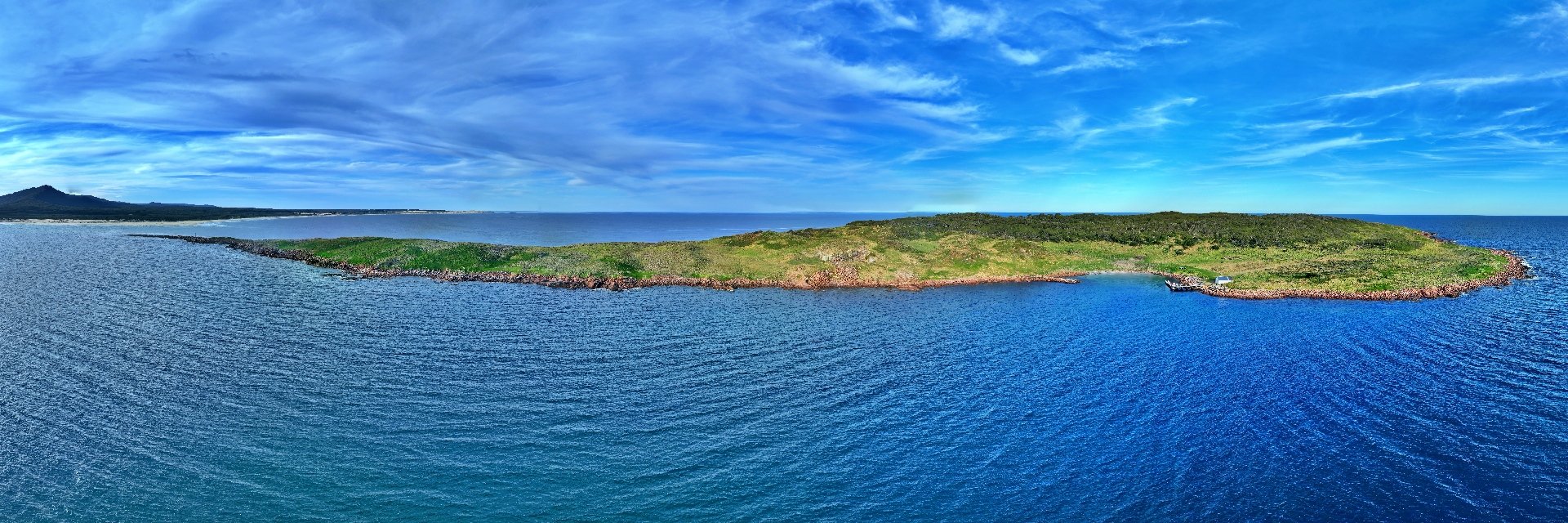
Gabo Island from the Sea
GEN-PANO-010The whole island from the water. Forested granite, a rocky cove and the East Gippsland mainland coast beyond.
Documentary Photograph: The eagle’s perspective of Gabo Island — granite reefs, coastal scrub, and the open waters of the Tasman Sea (Panorama by Colin Dixon).
There are moments on Gabo Island when something changes in the sky.
The gulls notice it first.
A bird appears above the island, hardly seeming to flap. Broad wings hold it against the wind. The body beneath them is startlingly white, the upper wings slate-grey, and the tail looks short and wedge-shaped.
It may circle once.
It may disappear toward the Tasman Sea.
Or it may suddenly fold those enormous wings and drop.
This is the White-bellied Sea-Eagle, one of Australia's great birds of prey — and on Gabo Island it arrives in a place where food can sometimes be counted in thousands.
Little Penguins breed below.
Short-tailed Shearwaters pour through the air and gather offshore.
Fish move through the surrounding reefs.
For a sea-eagle, Gabo is worth watching.
And for anyone standing beneath one, so is the eagle.
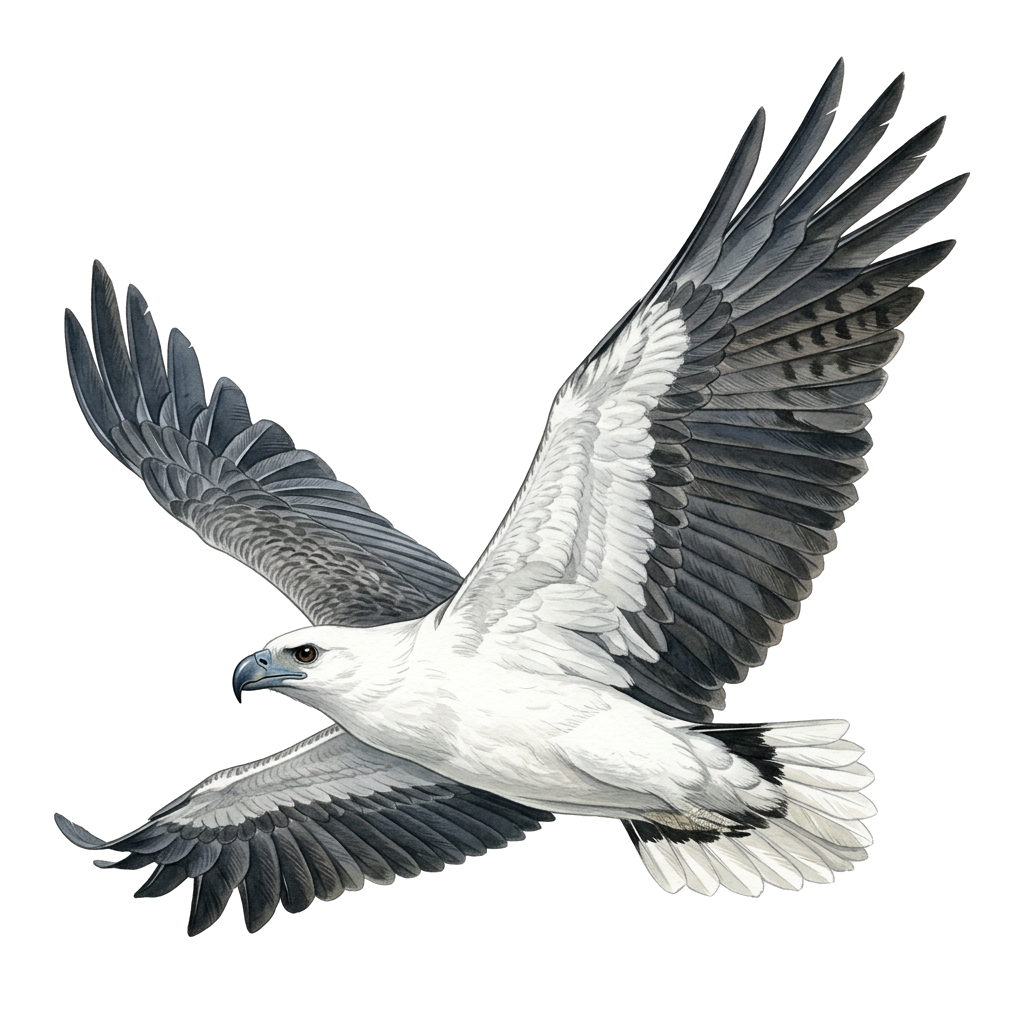
Haliaeetus leucogaster — adult in banking flight. The snow-white underside and dark outer flight feathers are its signature field marks.
White-bellied Sea-Eagle at a glance
| Common name | White-bellied Sea-Eagle |
|---|---|
| Older name | White-breasted Sea-Eagle |
| Scientific name | Haliaeetus leucogaster |
| Authority | (Gmelin, 1788) |
| Kingdom | Animalia |
| Phylum | Chordata |
| Class | Aves |
| Order | Accipitriformes |
| Family | Accipitridae |
| Genus | Haliaeetus |
| Species | H. leucogaster |
| Length | About 75–85 cm |
| Wingspan | About 1.8–2.0 metres |
| Male weight | Roughly 2.5–3.7 kg |
| Female weight | Roughly 2.8–4.2 kg |
| Global status | Least Concern |
| Victorian status | Endangered |
The Australian Museum and BirdLife Australia currently use Haliaeetus leucogaster. The Australian Faunal Directory accepts Haliaeetus (Pontoaetus) leucogaster. Some international taxonomies now place the species in Icthyophaga, so you may also encounter Icthyophaga leucogaster in newer databases.
An eagle you can recognise from underneath
Adult White-bellied Sea-Eagles are unusually easy to identify once you know what to look for.
The head, breast, belly and much of the underwing are white. The back and upper wings are grey, while the long flight feathers appear dark from below. The bill is large, strongly hooked and grey, and the feet are pale with formidable black talons.
Females are larger than males, but otherwise the sexes look similar (BirdLife Australia).
Young birds are another matter.
Juveniles are largely brown.
Over the next several years they progressively acquire patches of white and grey until the unmistakable adult plumage is complete at around four years of age (BirdLife Australia).
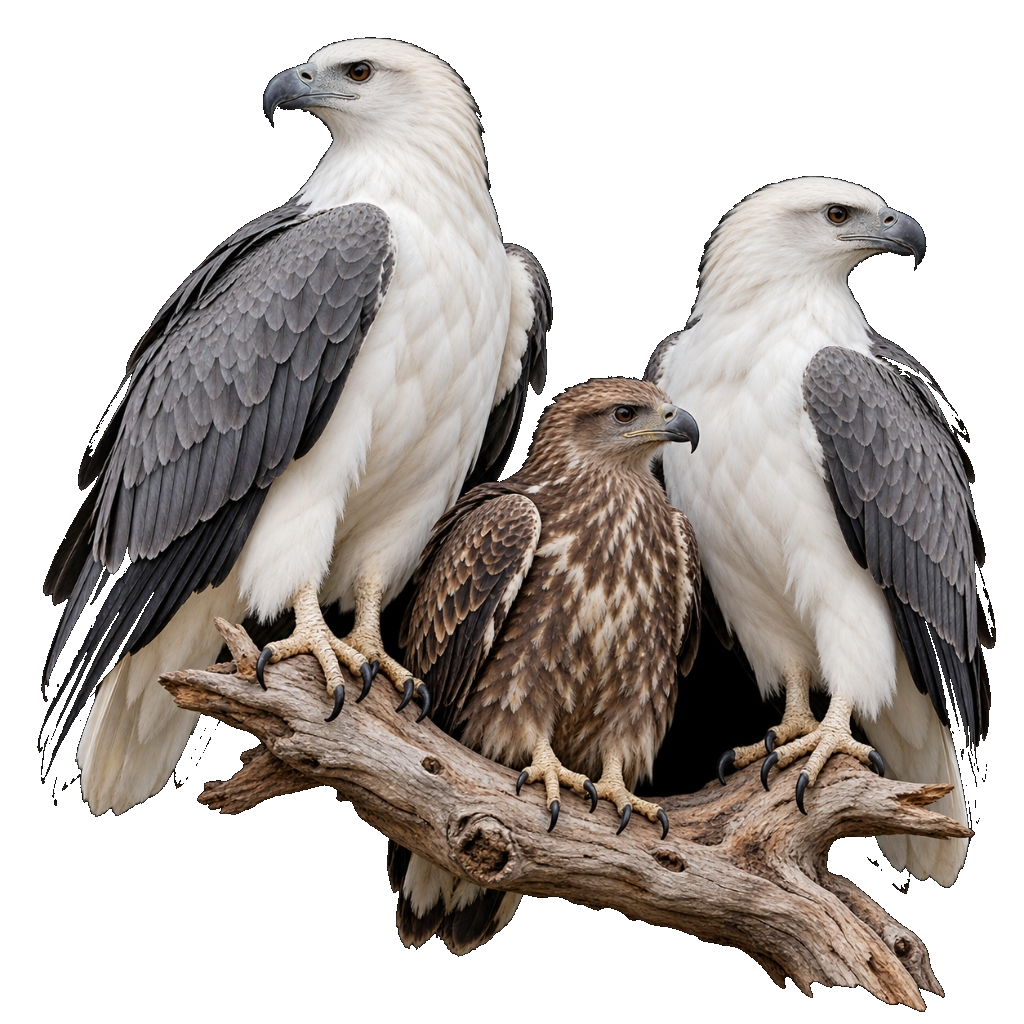
The Four-Year Transition
Adult plumage (flanking): Clean white head and breast, slate mantle, and fierce grey hooked bill.
Juvenile plumage (centre): Heavily mottled in dark brown. It takes four years of moults before an adolescent sea-eagle acquires its pure white chest and slate back.
So a big brown eagle over Gabo need not be a Wedge-tailed Eagle.
It may simply be a young sea-eagle that has not yet earned its white coat.
Built to watch water
The White-bellied Sea-Eagle is not confined to the sea.
Across Australia it occurs around coasts, estuaries, large rivers, wetlands and inland lakes. But water is the constant theme.
BirdLife describes them sitting high above waterways or soaring over water and adjacent land, while Victorian guidance describes a hunting style involving low hovering or a swooping dive to seize prey from the surface (BirdLife Australia).
Fish are important.
But this is not a fussy specialist.
White-bellied Sea-Eagles also take turtles, waterbirds, reptiles and mammals, eat carrion and sometimes rob other birds of food. BirdLife notes that they can tackle prey as large as a swan.
On Gabo, the menu becomes particularly interesting.
Gabo is a hunting ground
Parks Victoria specifically tells visitors to watch for White-bellied Sea-Eagles soaring above Gabo Island, particularly in spring.
The Parks Victoria visitor guide goes further.
It describes the island's huge numbers of seabirds as an important food source for raptors including White-bellied Sea-Eagles, Whistling Kites, Marsh Harriers and Brown Falcons.
And ornithologists have actually watched the hunting happen.
A long-running study of Gabo's birds reported White-bellied Sea-Eagles on almost every survey visit, usually between one and five birds, including both adults and immature birds. On several occasions researchers watched a sea-eagle fly across from the mainland and snatch a Short-tailed Shearwater from feeding flocks offshore (Corella / ABSA).
That is a useful detail.
Gabo's sea-eagles are not simply decorative shapes circling above a picturesque island.
They are working predators.
Penguins are on the menu too
Earlier Gabo observations make the relationship even clearer.
During surveys in the 1970s, researchers found remains of both Little Penguins and Short-tailed Shearwaters at White-bellied Sea-Eagle feeding sites.
One lighthouse keeper reportedly saw an eagle drop a penguin that was still warm.
Researchers were cautious about assuming every bird had been killed by the eagle — sea-eagles readily scavenge — but the observations make clear that Gabo's seabird colonies form part of the sea-eagle's food supply (Corella 1978).
That is nature doing what nature does.
On an island famous for penguins and shearwaters, it is tempting to divide animals into things we want to protect and things that threaten them.
The White-bellied Sea-Eagle does not recognise that distinction.
It belongs to the same ecosystem.
It was hunting seabirds here long before there was a lighthouse, an airstrip or a Parks Victoria sign.
The shearwater feast
There are times when the numbers become extraordinary.
Gabo bird surveys describe huge movements of Short-tailed Shearwaters past the island. On one October day in 1993, researchers estimated about 900 birds per minute passing west for much of the day.
In October 2000, enormous rafts of shearwaters were recorded feeding offshore on concentrations of krill. Estimates ranged from several thousand birds one day to more than 100,000 the next.
Sea-eagles took advantage.
Observers recorded White-bellied Sea-Eagles flying from the mainland to attack the feeding flocks at sea (Corella 2006).
Imagine the scene from above.
The water dark with feeding shearwaters.
Fish and krill below them.
And somewhere higher still, an eagle watching the whole thing.
“Gabo's wildlife does not exist as a list of separate species. It is a food web you can sometimes see operating in front of you.”
Does the sea-eagle live on Gabo?
This is where we should be careful.
White-bellied Sea-Eagles are regularly recorded hunting and soaring over Gabo, and adults and immature birds have repeatedly been observed there. Historical researchers also recorded birds crossing from the mainland to hunt around the island.
I have not found good evidence that Gabo itself supports a regular breeding pair.
That would make sense.
Sea-eagles generally build enormous stick nests, most often high in large trees. The same nest may be enlarged and reused for many years. Where suitable trees are unavailable, nests can occasionally be placed on cliffs, rocks or even the ground (The Australian Museum).
The taller forests and waterways of mainland East Gippsland provide far more conventional nesting habitat.
So for gaboisland.au, I would describe Gabo as:
an important feeding and hunting area regularly visited by White-bellied Sea-Eagles
rather than claim that they breed on the island.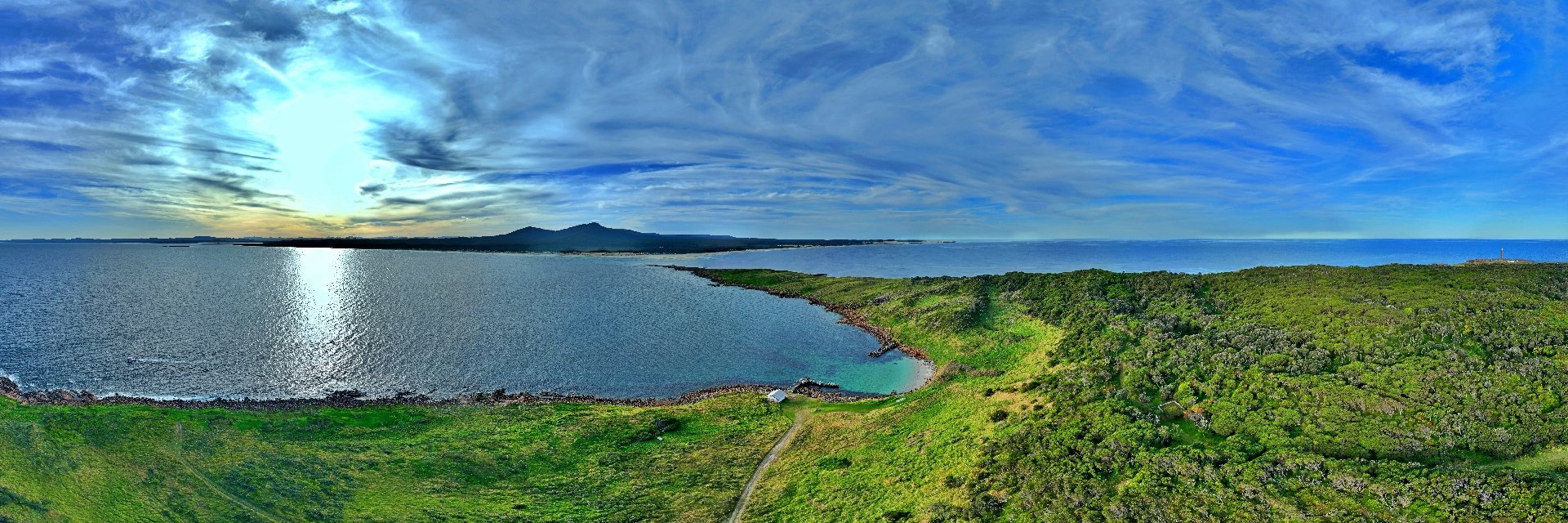
From Gabo Island to the Mainland
GEN-PANO-012Looking toward the mainland from the island. Sun on the water, the Howe Ranges and a glimpse of the lighthouse at the point.
Documentary Photograph: Looking west across the channel from Gabo Island toward the Howe Range and the East Gippsland mainland — the coastal forests and waterways where breeding pairs build their eyries (Panorama by Colin Dixon).
A nest built for years
Where they do breed, White-bellied Sea-Eagles build on a grand scale.
A pair constructs a huge platform of sticks and lines it with fresh green leaves and twigs.
The nest may be reused for many breeding seasons, with more material added each year. In trees, nests can sit as high as 30 metres above the ground (The Australian Museum).
BirdLife says pairs maintain territories throughout the year. The female performs most incubation, although the male also takes a turn (BirdLife Australia).
Australian Museum information gives the broader breeding season as May to October, although timing varies geographically. Victorian guidance says one or two eggs are typically laid, often between April and August.
Detailed Australian research has measured incubation at about 40 days, with young remaining in the nest for roughly another 11–12 weeks before fledging (Australian Field Ornithology).
It is not a fast reproductive strategy.
Protecting a successful breeding pair therefore matters.
Globally common. In Victoria, endangered.
This is another species where a global label does not tell the whole story.
Internationally, the White-bellied Sea-Eagle is classified as Least Concern. Its range extends beyond Australia through New Guinea and parts of South and South-East Asia (BirdLife Australia).
In Victoria, however, it is listed as Endangered (Victorian Wildlife / FFG Act).
Victorian information indicates the species has probably never occurred here in enormous numbers. Suitable breeding territories are large and nests are widely spaced.
The Victorian population therefore does not have to lose thousands of birds before losses become significant.
Every productive territory counts.
East Gippsland matters
For Victoria's White-bellied Sea-Eagles, the eastern coastline is particularly important.
A Victorian species assessment says the birds are most common along the coast between Gabo Island and Wilsons Promontory. It also identifies coastal and wetland habitats as central to the species' ecology (NatureKit Species Assessment).
Older research described East Gippsland as one of Victoria's main breeding areas for the species.
That puts Gabo at an interesting edge.
It is not simply an isolated island with an occasional eagle.
It sits within one of the most important White-bellied Sea-Eagle landscapes in Victoria.
And because Gabo concentrates seabirds, fish and other marine life into a relatively small area, it offers the eagles a particularly rich place to hunt.
What threatens an eagle?
For a bird capable of carrying prey from the sea and nesting thirty metres up a tree, the biggest problems are surprisingly ordinary.
Loss of large nesting trees is one.
Disturbance around active nests is another.
Victorian guidance notes that breeding White-bellied Sea-Eagles can be highly sensitive to people and may abandon nests or young if repeatedly disturbed. Pollution and contamination of aquatic food chains can also affect a predator sitting near the top of that chain (Land for Wildlife Notes).
The Victorian landscape has changed enormously since European settlement.
Coastal forests have been cleared.
Wetlands have been altered.
Large old trees disappear much faster than replacements can grow.
For an eagle whose nest may serve a pair for years, losing one tree can mean losing far more than one perch.
Listen before you look
For such an imposing bird, the White-bellied Sea-Eagle has an unexpectedly strange voice.
BirdLife describes its breeding call as a loud, goose-like honking (BirdLife Australia).
It does not sound much like the majestic cinematic eagle cry people expect.
Sometimes wildlife has little regard for branding.
On Gabo, you may hear one before you have found it.
Then look up.
How to tell it from a Wedge-tailed Eagle
At a distance, any enormous raptor can initially look like “an eagle”.
A few clues help.
An adult White-bellied Sea-Eagle has:
- a conspicuously white head and underside;
- grey upper wings;
- dark outer flight feathers;
- a relatively short, pale tail;
- very broad wings;
- a strong association with the coast and water.
A Wedge-tailed Eagle is much darker overall and carries the unmistakable long wedge-shaped tail that gives it its name.
Juvenile sea-eagles are more difficult because they are brown.
That is when shape, habitat and patience become useful.
If you see one on Gabo
Stop walking for a moment.
Do not worry about getting directly underneath it.
A White-bellied Sea-Eagle soaring above Gabo is often best appreciated as part of the landscape.
Watch how little effort it appears to use.
Watch the gulls.
Watch the shearwaters.
Watch whether it circles the coastline or turns out to sea.
There is a good chance it has noticed something long before you have.
If the bird is perched or feeding, give it distance.
And if you ever encounter a nest elsewhere, distance matters even more. White-bellied Sea-Eagles can be particularly sensitive to disturbance during breeding (Wildlife Victoria).
The view from above
Gabo is often described from a human point of view.
The pink granite.
The lighthouse.
The sea.
The wildlife.
A White-bellied Sea-Eagle sees another version.
Below it are reefs holding fish.
Along the granite edge may be carrion washed ashore.
In the vegetation are thousands of seabird burrows.
Offshore, shearwaters gather wherever the ocean produces food.
And beyond the island is only a short flight back toward the forests and waterways of East Gippsland.
The eagle ties all of those worlds together.
Sea and land.
Predator and prey.
Mainland and island.
You may spend an hour walking Gabo and see only one.
But one is enough.
A broad shadow crosses the granite.
You look up.
And suddenly the island seems smaller.
White-bellied Sea-Eagle
Haliaeetus leucogaster (Gmelin, 1788)
Also historically called the White-breasted Sea-Eagle. Australian authorities currently retain Haliaeetus leucogaster, although some newer international classifications use Icthyophaga leucogaster (Atlas of Living Australia / AFD).
Global conservation status: Least Concern · Victorian conservation status: Endangered (BirdLife Australia; Victorian FFG Act).