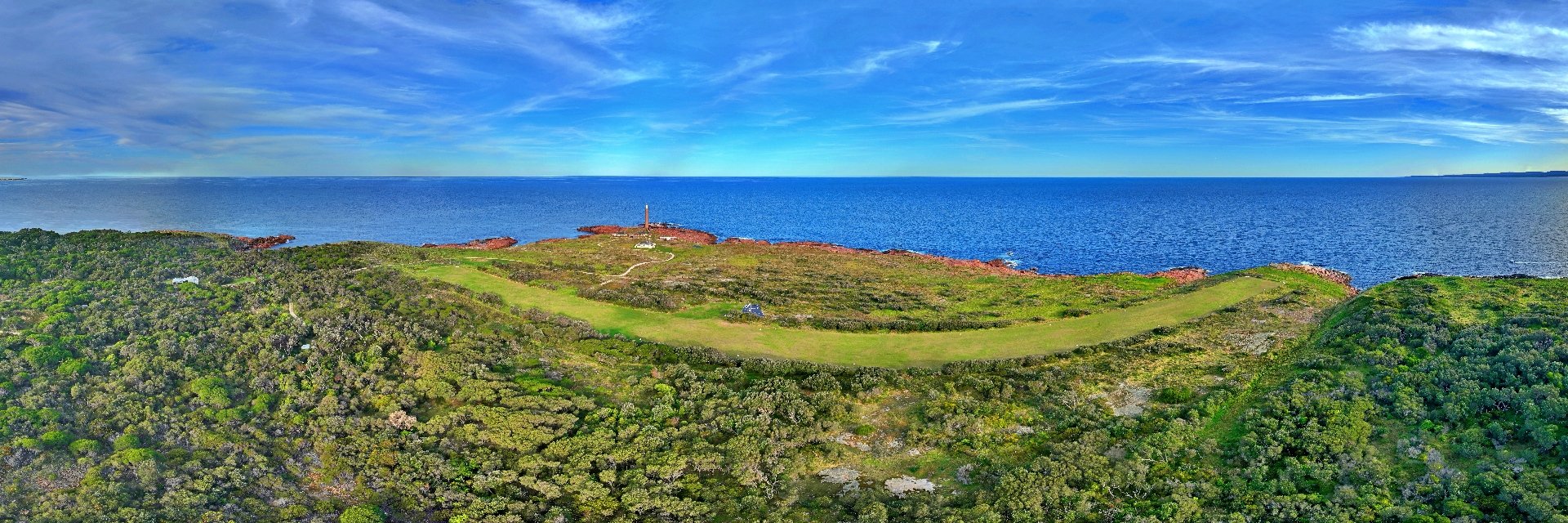
Gabo Island Airstrip
GEN-PANO-009The grass strip on the island. Coastal scrub, a green runway and the lighthouse standing on the granite point.
Documentary Photograph: Coastal heath, tussock scrub, and the central plateau of Gabo Island where Short-tailed Shearwaters excavate their underground burrows (Panorama by Colin Dixon).
At first glance, the Short-tailed Shearwater is not Gabo Island’s most glamorous bird.
It is dark brown, almost charcoal in poor light. It has a long narrow bill, narrow wings, a short rounded tail, and the slightly awkward manner of a bird that spends most of its life somewhere else.
That “somewhere else” is the point.
A Short-tailed Shearwater nesting on Gabo may leave its burrow, fly out over the Tasman Sea, feed hundreds or even thousands of kilometres away, return to raise a single chick — and then, once the breeding season is finished, head north across the vastness of the Pacific Ocean.
Not to Sydney.
Not to Queensland.
To the frigid, food-rich waters around Japan, Alaska, the Bering Sea, and the Arctic.
Then it comes back.
To the same southern corner of Australia. To the same island. Often to the same partner. And, remarkably often, to the very same patch of ground.
That makes the shearwaters one of Gabo Island’s truly great natural stories.
A Bird Designed for Another World
The Australian Faunal Directory and the Atlas of Living Australia accept the modern scientific name Ardenna tenuirostris. Older books and research papers will often refer to the bird as Puffinus tenuirostris; they are describing the same species. Museums Victoria characterizes the bird as uniform sooty-brown with long, slender pointed wings and a short, wedge-shaped tail (Museums Victoria Collections).
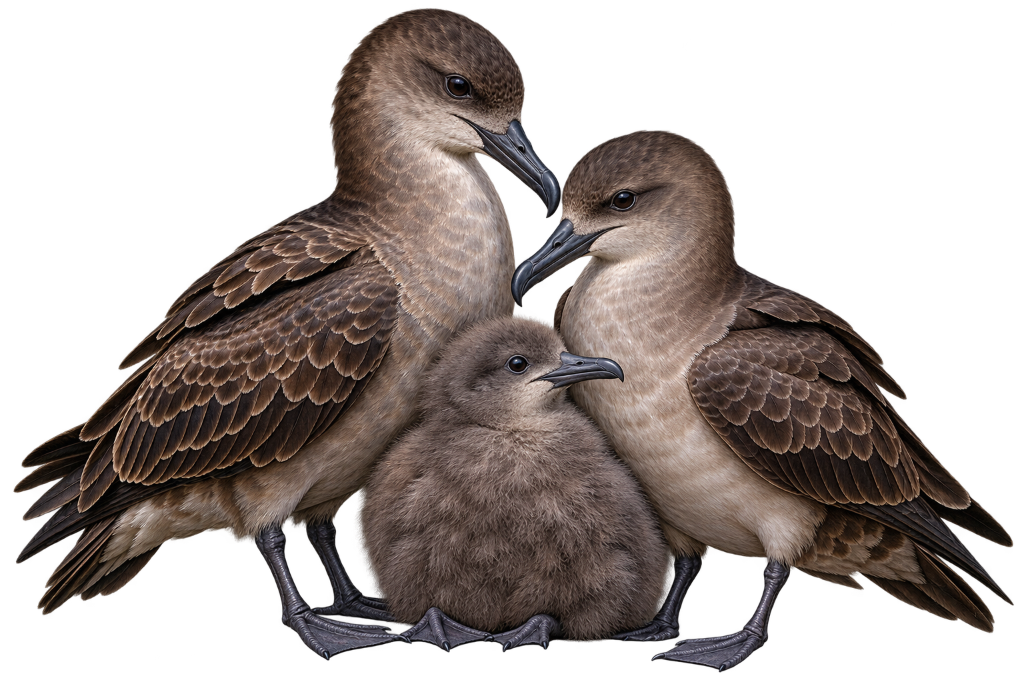
Ardenna tenuirostris — breeding pair with downy chick, showing hooked bills, dense waterproof plumage, and oceanic wing structure.
Short-tailed Shearwater at a Glance
| Common Name | Short-tailed Shearwater (Muttonbird) |
|---|---|
| Scientific Name | Ardenna tenuirostris (formerly Puffinus tenuirostris) |
| Family & Order | Procellariidae · Procellariiformes (Tubenoses) |
| Body Length | 40–43 cm |
| Wingspan | Approx. 95–100 cm (nearly 1 metre) |
| Weight | 500–800 g |
| Nest Structure | Underground chamber excavated in sandy soil or tussock |
| Clutch Size | Single white egg per breeding season |
| Primary Diet | Antarctic & coastal krill, small fish, squid |
| Annual Flight | Up to 30,000 km round-trip across the Pacific |
| Lifespan | 30+ years (long-term monogamous pair bonds) |
| Global Status (IUCN) | Least Concern |
Watch one land and the shearwater can look faintly ridiculous.
It has webbed feet set well back on the body — perfect for propulsion in the ocean, but clumsy on land. It shuffles, trips, and scrambles around its burrow entrance. Landings after dark in thick coastal scrub are not always graceful affairs.
At sea, it becomes an entirely different animal.
Long, narrow wings allow it to cover enormous ocean distances with almost zero energy expenditure. Its English name comes from the characteristic way shearwaters skim or “shear” across the surface of the sea, alternating stiff, rapid wingbeats with effortless banking glides mere millimetres above the wave troughs.
It also dives.
Short-tailed Shearwaters use their wings as underwater flippers and can reach depths of several tens of metres in pursuit of swarming prey. Australian Government Antarctic division records document dives down to around 50 metres, with most considerably shallower (Australian Antarctic Program). For a bird weighing well under a single kilogram, its operational range and athletic versatility are extraordinary.
Gabo Is Not Just Somewhere They Pass
Short-tailed Shearwaters breed on Gabo Island. Parks Victoria specifically lists them among the island’s primary breeding seabirds, alongside the much more famous Little Penguins (Parks Victoria).
Their presence is less obvious during the day because their entire domestic life takes place subterranean.
A shearwater colony is, in effect, a hidden city.
Beneath coastal tussock grass, pigface, and sandy soil, an intricate network of tunnels leads to individual nesting chambers. A single pair occupies each burrow and lays just one egg per season.
That makes every single successful chick invaluable.
The birds arrive back in southern Australia with clockwork synchrony each spring in late September. Egg-laying occurs around late November, chicks hatch during mid-summer, and the fledglings depart independently in late April. Both parents share the arduous work of incubation and feeding. Because shearwaters can live for more than 30 years and commonly reunite with the same partner year after year, a single bird may make the trans-hemispheric round trip between Gabo and the northern Pacific dozens of times across its lifetime.
How Many Are on Gabo?
This is one of those questions where citing a single confident number would be scientifically misleading.
Gabo has long been recognized as a major breeding colony, but historical estimates vary enormously depending on the census methodology used:
The Challenge of Counting Burrow-Nesting Seabirds
- 1971 Estimate: Around 1,000 breeding pairs recorded in early island surveys.
- 1977 Estimate: Only six years later, a broader survey suggested between 20,000 and 50,000 pairs.
- 2015 Deakin University Fieldwork: Researchers on Gabo cited an established baseline of more than 6,000 breeding pairs (Movement Ecology / Springer).
- 2025 Methodological Review: A landmark peer-reviewed review in Frontiers in Marine Science specifically used Gabo Island as a case study in how burrow density, quadrant sampling, and occupancy rates can produce vastly differing figures (Frontiers in Marine Science, 2025).
Scientific Takeaway: Gabo Island supports a major breeding colony of Short-tailed Shearwaters, historically estimated in the thousands to tens of thousands of pairs. Exact counts vary widely based on survey parameters, and ongoing research aims to provide more robust modern monitoring.
What Gabo’s Shearwaters Taught Scientists
Gabo has not simply been counted from a distance. Researchers have actually attached miniature GPS loggers and geolocators to breeding adults on the island to discover where they go when they disappear over the horizon.
Between 2012 and 2014, Deakin University scientists monitored nests and tracked birds foraging from Gabo. The telemetry data revealed an astonishing dual foraging strategy (ResearchGate / Deakin Study):
Local Foraging (20–80 km)
On short trips lasting 1 to 3 days, adults forage in local inshore waters off Gabo Island and Cape Howe. The sole purpose of these trips is to bring food directly back to nourish the growing chick.
Deep Southern Ocean (Antarctica)
Because feeding the chick steadily drains the parent’s own fat reserves, the adult periodically departs on a multi-thousand-kilometre voyage deep into Antarctic pack-ice waters to rebuild its own body mass before returning to Gabo.
Think about what that means in practice:
“There may be a small chick sitting underground on Gabo Island while one of its parents is diving for krill in sub-zero Antarctic waters thousands of kilometres to the south. And then that bird comes back.”
One Chick and a Stomach Full of Oil
Shearwaters possess an extraordinary biochemical adaptation for long-distance parenting.
Rather than hauling heavy whole fish across thousands of kilometres of open ocean, adult shearwaters digest their marine catch and convert it into a concentrated, energy-dense stomach oil.
This amber oil weighs far less than whole fish for the calories it delivers, making it the ultimate lightweight fuel for trans-oceanic transport. The chick receives hyper-concentrated nutrition.
Toward the end of the breeding season in autumn, shearwater chicks can become substantially heavier than their parents — spherical balls of down and fat. Eventually, in early April, the adult birds depart for the northern hemisphere, abandoning their chicks underground.
Then hunger performs a vital evolutionary task.
Over several weeks, the chick lives off its stored oil reserves. It sheds its down, exercises its flight muscles at the mouth of the burrow in the dark, and slims down to flying weight. Then, one April night, without a parent to guide it, the fledgling scrambles to a cliff edge, spreads its one-metre wings, and launches into the Tasman Sea.
Ahead lies the vast Pacific Ocean (Australian Antarctic Program).
One of the Great Migrations on Earth
After breeding, Short-tailed Shearwaters leave southern Australia in vast, undulating flocks. They journey northward through the central and western Pacific to spend the austral winter feeding in the productive waters of the North Pacific — around Japan, the Kuril Islands, the Bering Sea, the Gulf of Alaska, and north into the Arctic Ocean.
Modern satellite tracking has disproven the old theory that shearwaters merely drift along a passive "figure-eight" wind loop. In reality, their navigation is purposeful, dynamic, and direct. A complete annual circuit spans between 25,000 and 30,000 kilometres (Parks Tasmania).
The Gabo → Arctic → Gabo Flyway (~30,000 km)
Why Come Back to Gabo?
For an oceanic seabird, a predator-free breeding island is the most valuable real estate on the planet. Gabo provides rich coastal upwellings, deep soft soil for burrowing, and isolation from mainland foxes and feral dogs.
Gabo also represents a landmark conservation triumph: the eradication of feral cats.
At least 30 feral cats were known to be prowling Gabo Island prior to the late 1980s, wreaking havoc on nesting penguins and shearwaters. Between 1987 and 1992, a targeted eradication campaign eliminated every feral cat from the island. Rigorous wildlife surveys conducted between 1992 and 1998 found zero evidence of surviving cats — a permanent victory that secured the island’s burrowing seabird colonies (Ecological Management & Restoration / Wiley).
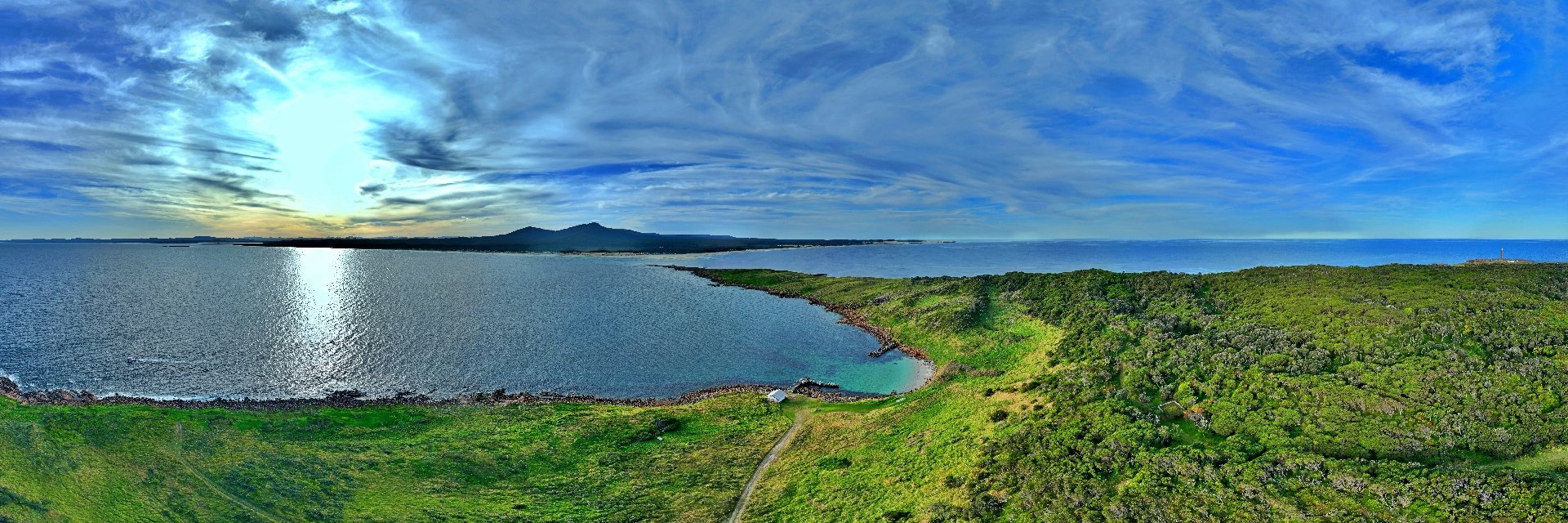
From Gabo Island to the Mainland
GEN-PANO-012Looking toward the mainland from the island. Sun on the water, the Howe Ranges and a glimpse of the lighthouse at the point.
Documentary Photograph: Looking west across the Tasman Sea from Gabo Island toward the Howe Range — the horizon over which shearwaters depart for Alaska each autumn (Panorama by Colin Dixon).
Rats, Mice, and Fragile Burrows
While cats are gone, island conservation is never a finished project.
Parks Victoria’s current East Gippsland Conservation Action Plan identifies invasive rodents — specifically introduced Brown Rats (Rattus norvegicus) and House Mice (Mus musculus) — as ongoing threats that prey on shearwater eggs and newly hatched chicks (Parks Victoria 2021).
The burrows themselves are also acutely delicate.
A shearwater tunnel can run just 5 to 10 centimetres beneath the soil surface. Walking off designated paths can inadvertently collapse the roof of a burrow, entombing an incubating adult or crushing a chick. BirdLife Australia strongly emphasizes that staying on formed tracks is the single most important action visitors can take to protect coastal seabirds.
Darkness Matters & The Rush of Wings After Sunset
Unlike penguins that waddle up from the ocean along the beach, shearwaters arrive from the sky.
Returning under cover of complete darkness is an evolutionary necessity to avoid Pacific Gulls and Sea-Eagles. Shearwaters use celestial cues — the moon, the stars, and subtle horizons — to navigate.
Because burrow-nesting seabirds are easily disoriented by bright artificial lighting, Australia’s National Light Pollution Guidelines mandate low-intensity, downward-directed red or warm lighting around breeding colonies (DCCEEW Seabird Guidelines).
For anyone privileged enough to stand on Gabo Island on a spring evening, the spectacle is unforgettable:
“A bird suddenly materialises out of the darkness, banks low over the coastal scrub, and drops into the tussock. Then another comes. And another. The quiet island fills with the whirr of wings, guttural coos, and the rustle of birds scrambling into their homes.”
A New Neighbour from Warmer Waters
An intriguing new ecological chapter is unfolding on Gabo.
The Wedge-tailed Shearwater (Ardenna pacifica), a species historically restricted to the subtropical waters of northern New South Wales and Queensland, has recently begun attempting to breed on Gabo Island.
A 2026 study published in Ecology and Evolution documents this southward expansion of the species’ breeding range (Wiley / Ecology and Evolution 2026). Gabo now sits at a fascinating biogeographic frontier where temperate subantarctic commuters share burrows alongside subtropical pioneers.
A Bird with Two Homes
Perhaps the most humbling truth about the Short-tailed Shearwater is how thoroughly it challenges our human definition of “home”.
For part of the year, it belongs to the icy waters of Alaska and the Arctic Ocean.
For another, it belongs to the pack ice of Antarctica.
Yet anchored underneath all those thousands of leagues of open sea is a particular hole in the sandy soil of Gabo Island, off the far corner of Victoria.
One egg is laid.
A chick waits underground.
And every spring, across 30,000 kilometres of ocean, the birds come home.