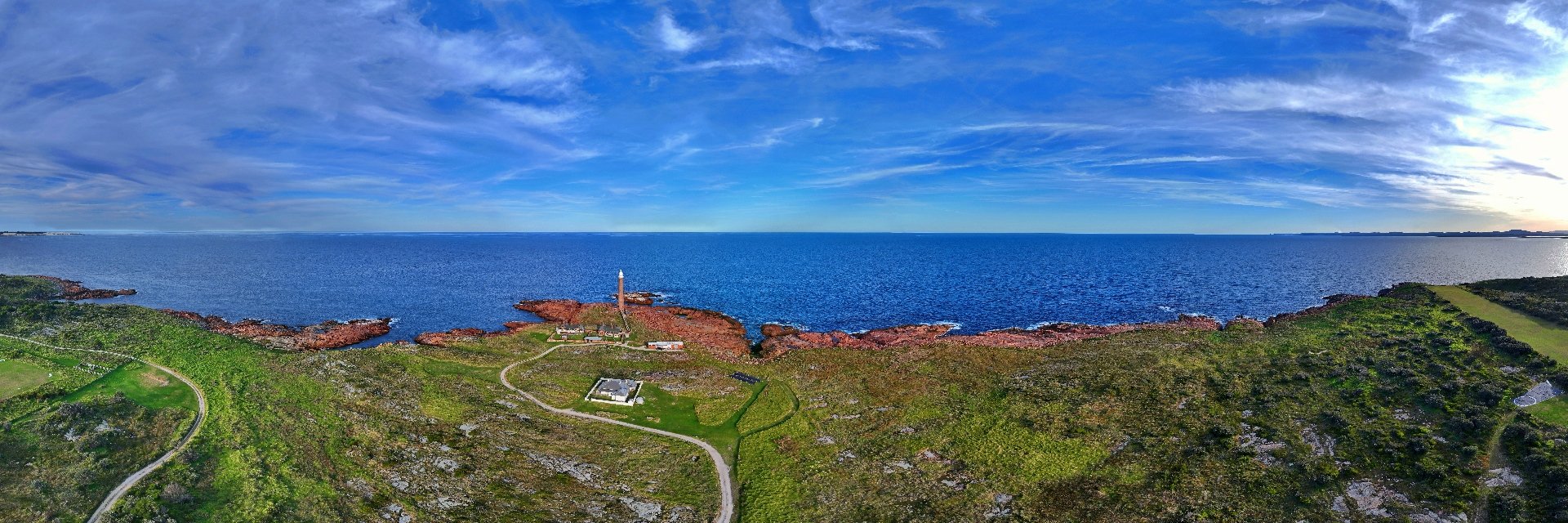
Gabo Lighthouse Station
GEN-PANO-011The station on the headland. Paths, cottages and the granite lighthouse against a long run of ocean.
Documentary Photograph: Late daylight fading across the granite shoreline and Tasman Sea at Gabo Island (Panorama by Colin Dixon).
There is a point in the evening on Gabo Island when the island changes shift.
The lighthouse has been doing its work for more than 160 years. The last daylight fades from the granite. Out beyond the rocks, the Tasman Sea turns from blue to grey and then almost black.
And somewhere offshore, very small birds are waiting.
Little Penguins spend much of their daylight at sea. They hunt underwater, chasing small fish, squid, and crustaceans with wings that long ago became flippers. They can stay away for days — sometimes much longer — before returning to land.
But they do not generally come ashore in broad daylight.
They wait.
Then, around dusk, groups begin moving towards the coast. A dark head appears between waves. Then another. Eventually, a bird barely 40 centimetres tall emerges from an ocean capable of throwing enormous swells against Gabo’s granite shore.
It stands up, shakes itself off, and starts walking home.
That nightly journey is one of Gabo Island’s great natural stories.
The World’s Smallest Penguin
The Little Penguin’s scientific name is Eudyptula minor. Australian birds are also commonly described as the Australian subspecies Eudyptula minor novaehollandiae. They belong to the penguin family Spheniscidae and the order Sphenisciformes (Australian Museum).
They are the smallest penguins in the world. BirdLife Australia gives a typical height of about 40–45 centimetres and a weight around one kilogram.
They also don’t look quite like the penguin of cartoons and Antarctic documentaries.
There is no dinner-jacket black across the back. In good light, a Little Penguin is unmistakably blue — slate, steel, and sometimes almost indigo across the head and upper body, with a white underside and pinkish feet.
That blue colouring is responsible for another common name: the Blue Penguin (or in New Zealand, Kororā).
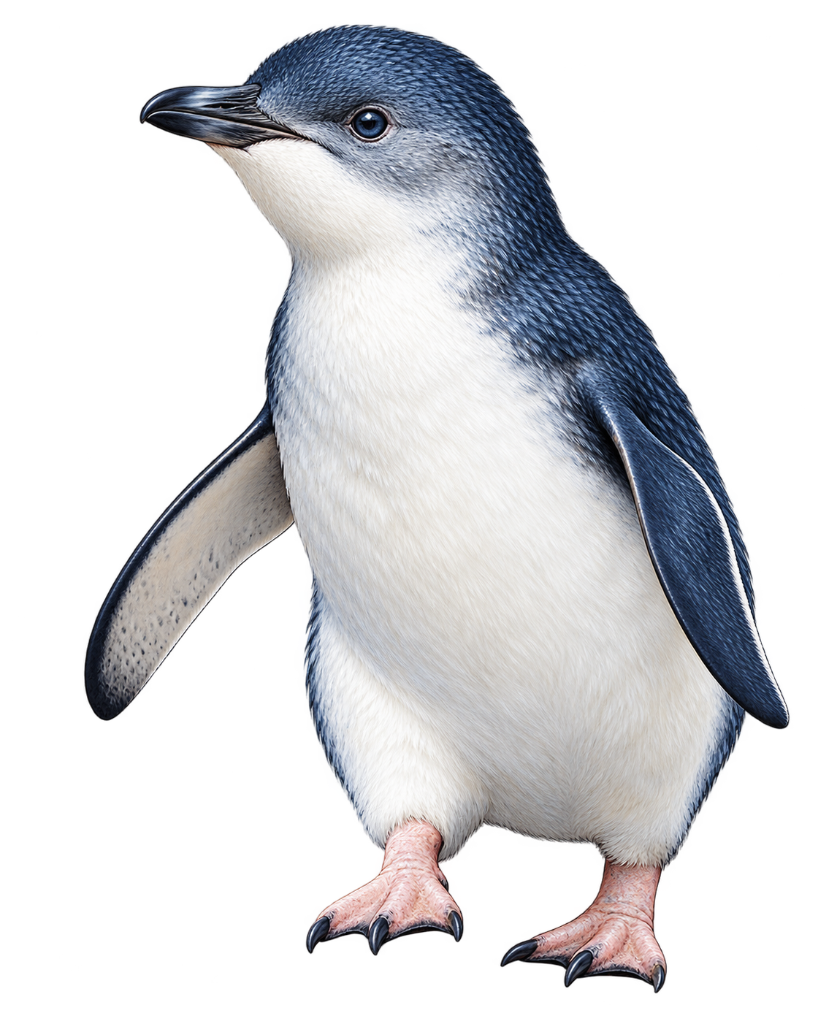
Eudyptula minor novaehollandiae — depicting characteristic indigo-blue dorsal plumage, compact hydrodynamic frame, and terrestrial waddling stance.
Little Penguin at a Glance
| Common Name | Little Penguin (Blue Penguin / Fairy Penguin) |
|---|---|
| Scientific Name | Eudyptula minor |
| Australian Subspecies | Eudyptula minor novaehollandiae |
| Family & Order | Spheniscidae · Sphenisciformes |
| Class | Aves |
| Average Height | 40–45 cm |
| Average Weight | Approx. 1.0–1.2 kg |
| Primary Prey | Small baitfish (anchovies, pilchards), squid, krill |
| Foraging Range | 14–20 km per day (dives typically 30 m; up to 70 m) |
| Global Status (IUCN) | Least Concern |
| Gabo Colony Trend | Steep Decline (Urgent Concern) |
Wear the Gabo Island Little Penguin. Available worldwide on classic tees, hoodies, mugs, and fine art prints.
View Collection on Redbubble →The global conservation classification is Least Concern, but that broad global label can hide what is happening to individual colonies. Gabo is a stark example (Australian Museum).
A Bird That Belongs to the Sea
On land, the Little Penguin can look almost comically ill-equipped.
It waddles. It climbs awkwardly. It argues loudly with its neighbours in guttural barks and harsh squawks.
Put the same bird in the water and everything changes.
Its compact body becomes a streamlined underwater torpedo. Its wings become powerful flippers, and its short tail acts as an agile rudder. BirdLife records dives ranging from just a few metres down to nearly 70 metres, although around 30 metres is most typical. In a single day’s foraging run, a penguin may cover between 14 and 20 kilometres across the Tasman Sea (BirdLife Australia).
“They are not really land birds that happen to swim. They are marine animals that have to come ashore to breed.”
That distinction helps explain Gabo Island.
The island offers both sides of the ecological bargain: secure nesting country above the high-tide line, and exceptionally rich, upwelling-fed marine habitats surrounding it. Little Penguins from Gabo regularly forage across nearby protected oceanic waters, including Cape Howe Marine National Park (Parks Victoria).
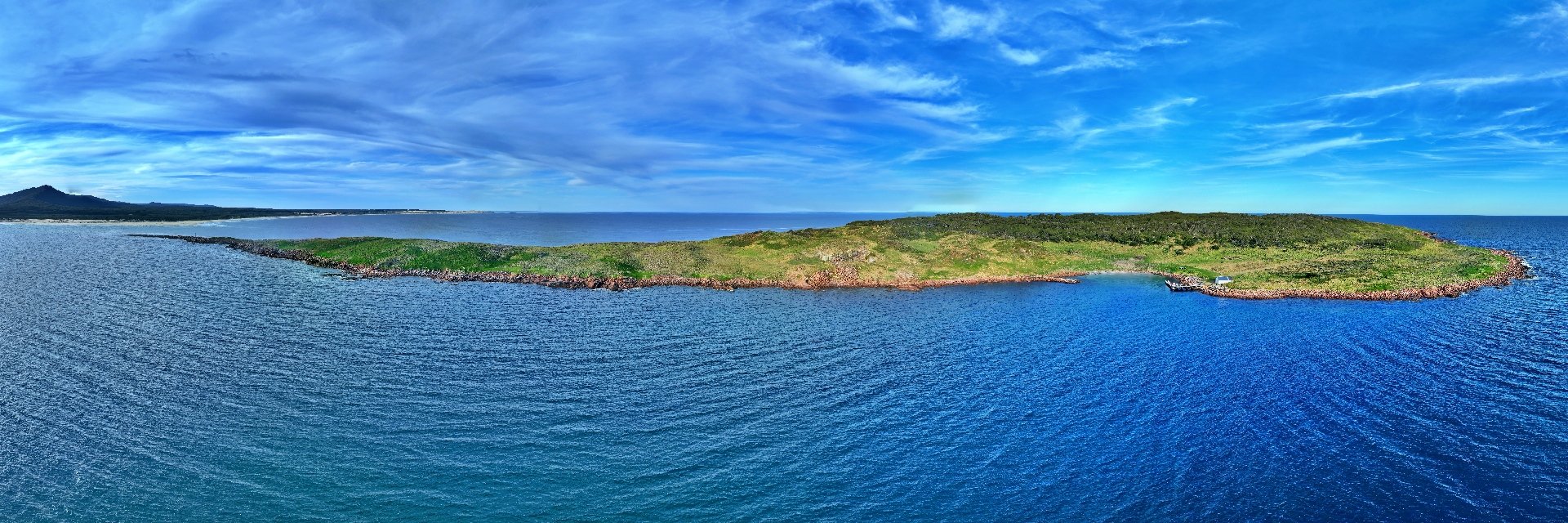
Gabo Island from the Sea
GEN-PANO-010The whole island from the water. Forested granite, a rocky cove and the East Gippsland mainland coast beyond.
Documentary Photograph: Gabo Island from the sea, showing the rocky coastal coves and surrounding open waters of the Tasman Sea (Panorama by Colin Dixon).
The Other Gabo Island
Visitors naturally notice the lighthouse. It is difficult not to — a 47-metre monolith of pink granite standing alone against the sky.
But beneath the vegetation and away from the buildings is another island — an island of burrows, tracks, and nocturnal movement.
Little Penguins generally nest in excavated burrows, rock crevices, or sheltered hollows beneath dense shrubs. They can travel surprisingly far inland from the shore, climbing steep granite ramps and traversing sandy ridges to reach their burrows. Both parents share the demanding work of incubating eggs and feeding growing chicks (BirdLife Australia).
Gabo has long been regarded as an exceptionally important breeding refuge. Parks Victoria officially designates the island as holding State Zoological Significance and notes that it has historically supported one of the world’s largest Little Penguin breeding colonies. Both Gabo and neighbouring Tullaberga Island are recognized globally as Important Bird and Biodiversity Areas (IBAs).
That significance makes what happened next particularly troubling.
How Many Penguins Are There?
There isn’t one simple number — and that is a story in itself.
An older Parks Victoria technical study estimated approximately 35,000 breeding pairs on Gabo. A rigorous CSIRO survey in 1994 produced an estimate of about 20,000 breeding pairs (Parks Victoria Technical Series).
Those historical estimates built Gabo’s international reputation as a thriving penguin stronghold.
More recent research reveals a starkly different reality.
By 2019, university and agency researchers cited by the ABC estimated roughly 9,000 breeding pairs remained on the island (ABC News, 2019).
A Victorian Government scientific assessment published in the State of the Marine and Coastal Environment (SMCE) Report 2024 subsequently reported an alarming change in burrow counts:
Burrow Count Collapse (CES Scientific Assessment 2024)
Note on scientific methodology: Burrow counts and breeding-pair estimates measure different parameters and should not be treated as directly interchangeable numbers. Nonetheless, both indices document an overwhelming downward trajectory.
In October 2024, retiring Gabo Island caretaker Leo op den Brouw — who lived and worked on the island for 25 consecutive years — reflected on what he had witnessed first-hand. He told the ABC that over his quarter-century tenure, he had observed the population plunge from roughly 30,000 pairs down to about 10,000 pairs (ABC News, 2024).
Today, the Threatened Species Conservancy officially classifies the Gabo colony as being in steep decline, noting that the island once sustained up to 21,000 breeding pairs and that urgent, targeted interventions are essential to prevent catastrophic colony collapse.
“So the responsible description is not:
‘Gabo has 25,000 Little Penguin breeding pairs.’
It is:
Gabo Island has historically supported one of the world’s great Little Penguin colonies, numbering in the tens of thousands of breeding pairs, but the colony has declined dramatically and its present population is substantially lower.”
What Happened?
There does not appear to be one single villain.
That is often the difficulty with complex ecological decline. Gabo’s Little Penguins live at the vulnerable intersection of a terrestrial ecosystem and a marine one. Pressures in either sphere reverberate directly through the colony.
Habitat Alteration & Predation
- Invasive Kikuyu Grass: Introduced pasture grasses form dense, impenetrable horizontal mats up to a metre thick. Returning penguins cannot penetrate the thick turf to reach their burrows or dig new nests (ABC News).
- Smothering Woody Weeds: Invasive Mirror Bush (Coprosma repens) and African Boxthorn (Lycium ferocissimum) colonise coastal slopes, choking out native salt-marsh herbs and Poa tussocks.
- Rodent Predation: Black rats (Rattus rattus) infiltrate burrow networks, taking vulnerable eggs and preying upon recently hatched chicks.
Ocean Warming & Marine Dynamics
- Rising Sea Temperatures: South-eastern Australia is a recognized global ocean-warming hotspot. Warmer currents displace cold, nutrient-rich upwellings, suppressing local supplies of pilchards, anchovies, and krill (CES Victoria).
- Extended Foraging Journeys: When schooling fish shift southward or into deeper water, adult penguins must swim much farther each day, leaving chicks unattended and undernourished for longer intervals.
- Apex Marine Predation: Expanding colonies of Long-nosed Fur Seals (Arctocephalus forsteri) in the Tasman Sea hunt penguins in nearshore waters.
No single explanation neatly accounts for the full magnitude of the decline. That uncertainty matters. Nature rarely arranges itself into the simplistic narratives humans prefer.
Trying to Turn It Around
There is now serious, coordinated scientific attention focused on Gabo’s penguins.
Under the Gabo Island Little Penguin Rapid Response Project, a dedicated coalition led by the Threatened Species Conservancy — working closely with Parks Victoria, Phillip Island Nature Parks, and the Friends of Mallacoota — is deploying on-ground rescue measures:
Artificial Nesting Burrows
Installing predator-resistant artificial burrows in cleared corridors to provide safe, immediate nesting hollows while native vegetation recovers.
Targeted Weed Eradication
Systematic removal of kikuyu mats and woody weeds across primary nesting dunes to restore natural burrowing soil (Parks Victoria 2021).
Systematic Colony Monitoring
Conducting regular microchip tagging, burrow occupancy checks, and chick fledging success audits to identify critical breeding bottlenecks.
Rodent Suppression
Implementing precision baiting and trapping regimes to eradicate black rats from key breeding gullies and prevent chick predation.
This work is vital because a penguin colony is far more than an abstract count of birds.
A colony is inherited knowledge.
Adults remember precisely where to come ashore. Birds return to the exact coordinates of their birth. Burrows are rebuilt, expanded, and handed down across seasons. Each successful breeding year connects one generation directly to the next.
If enough of that continuity is lost, restoring a colony becomes vastly more difficult than simply protecting an empty stretch of coast.
If You See Them
For guests staying at the heritage Assistant Lightkeepers Cottage, observing penguins return ashore is an unforgettable privilege. Parks Victoria notes that the peak period for watching Little Penguins return is after dark from August to December (Parks Victoria).
The natural temptation is to get closer.
Don’t.
For a small bird emerging exhausted from the ocean, that open strip of sand and granite between the breaking surf and its burrow is its road home. A human standing in that path becomes an overwhelming obstacle, forcing the bird back into the freezing sea or causing it to abandon hungry chicks.
Colony Welfare & Viewing Guidelines
- Red Light Only: Standard white torch beams and smartphone lights cause instant night-blindness and disorientation in Little Penguins, exposing them to predatory Pacific Gulls. Only low-intensity red-filtered torches or headlamps are permitted on Gabo Island after dark.
- No Flash Photography: Camera and mobile flashes are strictly prohibited by Victorian wildlife regulations.
- Give Them Wide Berth: Remain seated or stationary on established paths at least 5 to 10 metres away from tracks and burrows. Never corner or pursue a penguin.
- Watch in Silence: Little Penguins rely heavily on auditory calls to locate mates and chicks amidst thousands of burrows. Keep noise to a whisper.
There are many wildlife encounters where getting closer enhances the experience. Penguins are different: the encounter is infinitely more magical when you sit quietly in the dark and let them come to you.
Small Bird, Big Island Story
Gabo is an island built to withstand massive scale.
The lighthouse was engineered to be seen across leagues of wild ocean. Its pink granite blocks weigh tons. Gale-force storms arrive from the Antarctic without regard for human plans.
The Little Penguin operates at the opposite scale.
Forty centimetres high. A single kilogram of muscle, bone, and waterproof down.
Yet thousands of these tiny navigators have crossed the same waters, scaled the same sheer granite ledges, and vanished into the same coastal scrub night after night, generation after generation.
Long after the day’s boat transfers have returned to Bastion Point and the lighthouse has become the only visible beacon in the blackness, another Gabo Island begins to stir.
A wave breaks.
A little blue head appears.
And one more penguin comes home.