SS Monumental City
An American screw steamer that struck Tullaberga Island, near Gabo, on her first run back from Melbourne in May 1853. Thirty-seven people died. Her loss led to the building of the Gabo Island lighthouse.
The story
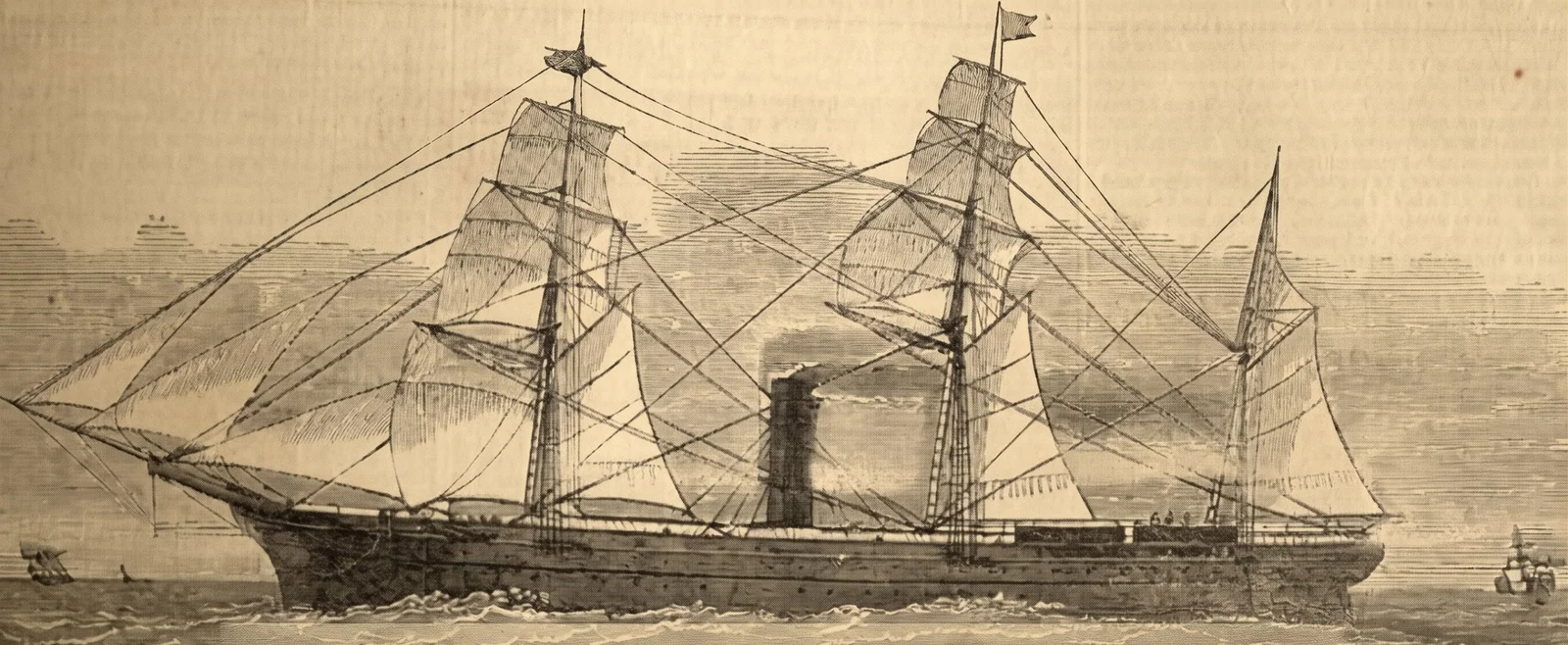
The Monumental City was a wooden single screw steamer built by Murray and Hazlehurst at Baltimore, Maryland, in 1850. She was 174.83 feet (about 53 metres) long, carried three masts, and was driven by two oscillating steam engines. Heritage Victoria notes she was unusual for an American steamer of her day, as most were paddle steamers.
She was first meant for the Hawaiian trade, which did not pay, and was then put on the California gold rush run, carrying passengers to San Francisco from Central America. Her engines proved slow and unreliable. In May 1852 she arrived at San Francisco from San Juan del Sur, Nicaragua, under Captain Cressey.
When gold was found in Victoria, her owner, Peter Stroebel, sent her across the Pacific. She left San Francisco on 17 February 1853 under Captain William Henry Adams and reached Sydney on 23 April, a passage of 65 days, as one of the first steamers to cross the Pacific. Her first Australian run took 166 passengers south to Melbourne for the goldfields.
The night of the wreck
She left Hobsons Bay for Sydney at about 11 am on Friday 13 May 1853, with a near miss at a buoy on the way out. The only cabin passenger to survive counted 11 cabin passengers, three of them women, and 23 in steerage. The crew numbered 45, and the owner, Peter Stroebel, was aboard.
The inquiry later heard that no position sightings had been taken on the whole trip from Sydney, and none at noon on the Saturday because the sun was hidden. Neither the captain nor the chief officer had sailed this coast before. The two compasses disagreed by up to two and a half points, and no depth soundings were taken that night. The Empire reported that a passenger who had been a ship’s master warned the officers she was hugging the land.
At midnight the chief officer, Edward Van Sice, took the deck with orders to round Cape Howe and then steer north-north-east. At about 1 am he saw breakers and turned out to sea, then worked back to his course over the next few hours without telling the captain. At about 3:45 am on Sunday 15 May, in rain and darkness, she slid up onto a flat rock at Tullaberga Island.
A steerage passenger, James Wheeler, heard Captain Adams ask the mate what made him run her so close to shore. Van Sice replied: “Why if I had followed the course you ordered she would have been wrecked three hours ago.”
On the rocks
The sea was calm and the engines could not back her off. The captain and passengers agreed to wait for daylight, and some passengers went back to bed.
At dawn the wind swung to the south-east and rose to a gale. The ship began pounding on the rocks, water put out the engine fires, and the foremast was cut away. The women would not get into a boat in the surf. Two boats were smashed and a third was carried away.
Fireman Charles Plummer took the last boat, the lifeboat, to the rocks with a line. That line broke on the rocks, but a piece of wood with spunyarn tied to it finally drifted to him, and he hauled the ship’s hawser ashore. One idea on board had been to send the ship’s Newfoundland dog ashore with a line. People crossed the hawser hand over hand or in rope slings through heavy surf. Several were washed off, and Plummer pulled many out of the water.
Captain Adams crossed the hawser at about 11:45 am. Some survivors said he left the passengers to their fate. Others said about half of those saved followed his example across. The owner, Captain White, Mr Urie and the women and children stayed with the wreck, hoping it would drift ashore. Just after 1 pm the ship broke apart and everyone still aboard was lost.
Survival on Tullaberga
Fifty-four people reached the island. It was about a quarter of a mile around and a mile off the mainland. They lit fires, dried their clothes and found fresh water among the rocks.
Bodies washed ashore over the next few days. Twenty-seven were recovered and buried on the island, and five were never found. Captain Adams read the burial service from a prayer book found on one of the drowned women. Gold dust, sovereigns, bank notes, watches and jewellery found on the bodies were handed into his care.
On Tuesday 17 May the captain and 18 men took the lifeboat to the mainland. The surf stopped them getting back, so they walked to Twofold Bay, living partly on shellfish, and arrived on the evening of Friday 20 May. A Mr Allen met some of them on the way with food and put them up for the night.
On the Friday some seamen built a raft from the wreckage, reached the mainland and brought the lifeboat back to ferry everyone across. They reached Twofold Bay on Sunday 22 May, where the Sub-Collector of Customs, Stewart Mowle, found them lodgings.
Those lost
Among the dead named in the Sydney Morning Herald were the owner, Peter Stroebel; Mr and Mrs Stubbs and their child, of Geelong; Mr Urie, a Glasgow stockbroker; Mrs Wilson; Charles Hopcott; William O’Gorman; James Porter; Charles Sweet; and Dr David Roll. Captain Adams told the inquiry that Captain White was also lost. The paper printed the names of the survivors too, among them Charles Plummer and the only surviving cabin passenger, Gavin McHarrow.
The inquiry
At Captain Adams’ own request, the New South Wales Steam Navigation Board held an inquiry at the Sydney Custom House from 8 to 10 June 1853, with Captain H. H. Browne in the chair and the American Consul present. The Board said it had no legal power to hold one on its own.
Van Sice said he had often changed course without reporting it and had never been told to report. Adams said no master would allow that, and that the mate had mistaken a nearby point for Cape Howe. Adams also said Tullaberga was not shown on the official chart he had been given, and that he had not known of a newer chart by Captain Stokes. He told the Board the engines needed repairs that had been put off because opening the valves let in water.
Gavin McHarrow blamed the loss of life on the failure to get a second line along the hawser, and on the captain leaving the ship. Several crew said no woman could have crossed that hawser. The Portuguese helmsman gave his evidence through Captain Adams, the only person present who could interpret.
Aftermath
Later in June the New South Wales Legislative Council debated the wreck. The ship had been surveyed under the Board’s direction and given a sea-going certificate, yet one member told the Council that Adams admitted he had never sailed in a less seaworthy vessel, and called the inquiry a farce. The Crown law officers said the colony had no power to prosecute the officers of a foreign ship for an offence on the high seas, and members called for colonial law to cover foreign ships in the trade between the colonies.
Heritage Victoria and the South Coast History Society both record that the wreck led to the building of the first lighthouse on Gabo Island. A memorial on Gabo Island, erected by the governments of Victoria and New South Wales, remembers those drowned, whose remains lie buried on Tullaberga Island.
The gold legend
In 1896 a survivor, Mr Roberts, claimed the ship had been carrying two safes of gold. In 1919 the son of another survivor said crew members had saved the treasure and hidden it, planning to come back for it. Nothing was ever found, despite several treasure hunts. The 1853 reports do confirm that gold dust, sovereigns and other valuables were recovered from the bodies, and McHarrow told the inquiry he had lost a bag of 500 sovereigns.
The wreck today
The Monumental City was declared a historic shipwreck under the Commonwealth Historic Shipwrecks Act on 11 March 1982, and maritime archaeologists surveyed the site in October 1984. The wreck lies in very shallow water with little of her structure left. Her engine, propeller and three anchors remain, with scattered broken crockery, and Heritage Victoria holds 39 objects recovered from the site. The surviving engine parts and propeller are considered significant because they show the change from wooden-hulled steamships to iron screw steamers.
Where the records differ:
Date: most records give 15 May 1853. The heading of the 1853 inquiry report says 16 May, and the memorial says 18 May.
Lives lost: Heritage Victoria and the South Coast History Society give 37. The 1853 newspapers gave 33, and McHarrow counted 32.
People aboard: McHarrow counted 80. The South Coast History Society gives 45 crew and 46 passengers, which is 91. With 54 saved, 91 aboard fits the figure of 37 lost.
Cabin passengers: McHarrow’s first account gives 11. Heritage Victoria lists 8.
Pacific crossing: Heritage Victoria and the South Coast History Society call her the second steamship to cross the Pacific. A 1985 Flinders University paper and The Shipwreck Archives call her the first.
Route before Australia: Heritage Victoria’s history names the Panama to San Francisco run. Its statement of significance and a San Francisco arrival record name Nicaragua.
Boats: the South Coast History Society says three boats were smashed. The 1853 accounts say two were smashed and the third carried away.
Speed: the Empire reported about 12 knots. McHarrow said 8, the second officer measured 10 on his watch, and the chief officer said 7 before she struck.
Warning: the Empire said a passenger who had been a ship’s master warned the officers. At the inquiry the officers denied any warning, but the American Consul said Van Sice had admitted to him that Mr Urie warned him.
Names: the owner is spelt Stroebel, Stroeberl and Stroabel in 1853 reports, and Heritage Victoria gives M. Strobed. The surviving cabin passenger is spelt McHarrow, M’Kerrow and McKerrow. Charles Plummer is called a seaman in early reports and a fireman in his own evidence.
From the archives
Read, watch and listen
Enjoy the history?
Watch the songs and drone films on the Mallacoota2020 YouTube channel, and subscribe to support more stories from this coast.
More wrecks on this coast
The Schah
A Hobart to Sydney schooner lost in a gale on the coast near Mallacoota in 1837, and the second oldest identified wreck in Victorian coastal waters.
12 September 1885Harry Leonard
A locally built bark stranded in Mallacoota Inlet in the year she was built. Her final fate is uncertain.
16 May 1893Star of Mallacoota
A ketch built at Mallacoota in 1891 that left for Melbourne in 1893 and was never heard of again.
31 July 1898Emily (1898)
A Mallacoota-owned cutter that left Eden in ballast and foundered in heavy weather. Her dinghy and a cap washed up at Tullaberga Island.